For
CommercialSoapDispenserAuto.com
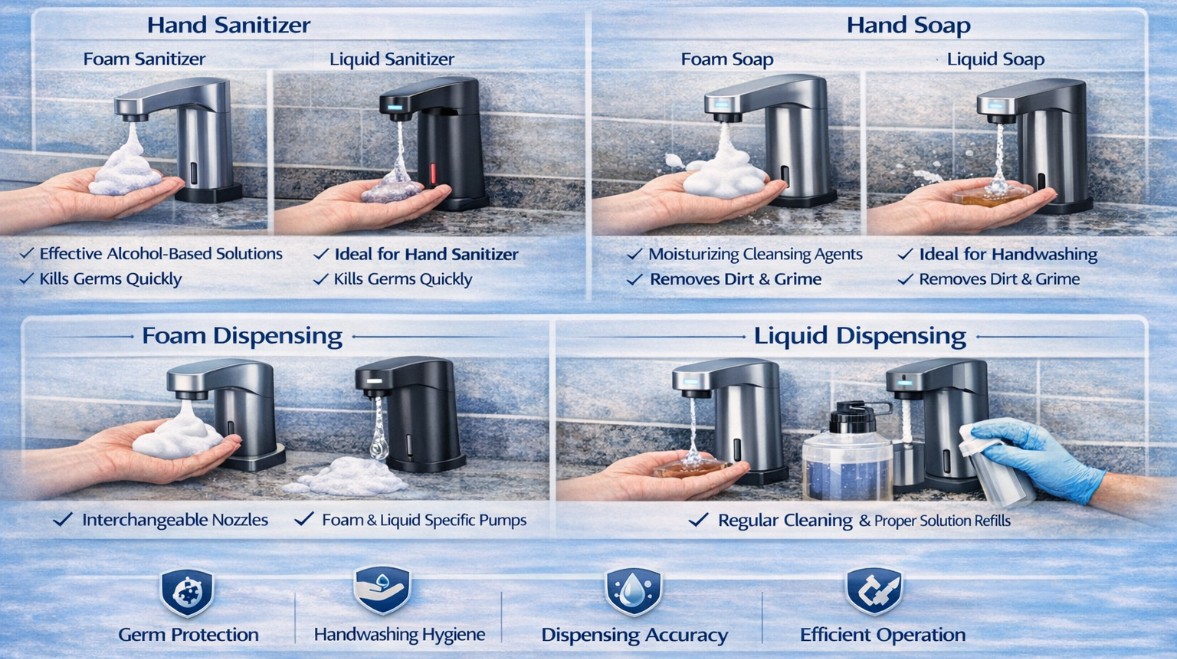
Sanitizer vs Soap: Compatibility and Dispensing Considerations for Foam vs Liquid
Automatic dispensers are often specified as a finish level accessory, but the liquid inside them drives most of the performance outcomes. Soap and hand sanitizer behave differently in pumps, valves, and nozzles. Foam and liquid formats add another layer because they change viscosity, dosing volume, residue, and user behavior at the sink.
In AEC projects, the practical goal is consistent hygiene performance with predictable maintenance. That requires matching the dispenser system to the product type, the refill method, and the code conditions in the building.
Working definition
In this article:
Soap means a product intended to be used with water at a sink, then rinsed off.
Alcohol-based hand sanitizer means a leave-on hand rub product, typically ethanol or isopropyl alcohol based, used when soap and water are not available. CDC guidance for community settings recommends sanitizer with at least 60 percent alcohol when soap and water are unavailable.
https://www.cdc.gov/clean-hands/about/hand-sanitizer.html
https://stacks.cdc.gov/view/cdc/45127
Foam means the dispenser mechanically mixes air into the product stream or uses a foaming formulation to produce foam at the nozzle.
Liquid means the dispenser delivers the product as a liquid stream or gel, without foaming mechanics.
Soap vs sanitizer: what changes for specifiers
Soap is the baseline for sink zones
CDC guidance emphasizes washing hands with soap and water as the best way to get rid of germs in most situations. This matters in AEC planning because sink areas are designed around soap use, rinse patterns, and drainage.
https://www.cdc.gov/clean-hands/about/hand-sanitizer.html
Soap systems also interact with water use, splash, and countertop staining, which influences how you place the dispenser relative to the basin.
Sanitizer adds code and placement considerations
Alcohol-based hand rub products are flammable liquids and are treated differently by fire codes and healthcare standards for corridor placement and container size.
The 2018 International Fire Code has a dedicated section for alcohol-based hand rubs.
https://codes.iccsafe.org/s/IFC2018/chapter-57-flammable-and-combustible-liquids/IFC2018-Pt05-Ch57-Sec5705.5
Healthcare environments often reference NFPA criteria for corridor dispenser placement, spacing, and maximum individual dispenser capacity. The Joint Commission summary of corridor dispenser requirements references limits such as 1.2 L maximum individual dispenser fluid capacity in corridors and areas open to corridors, plus spacing and outlet clearance rules.
https://www.jointcommission.org/en-us/knowledge-library/support-center/standards-interpretation/standards-faqs/000001560
CDC also publishes healthcare-focused hand sanitizer fire safety guidance.
https://www.cdc.gov/clean-hands/media/pdfs/cdc-abhs-firesafety-508.pdf
Design takeaway:
If sanitizer dispensers will be placed in corridors, entries, or suites, confirm the local adopted code and facility policy early, then coordinate container size, spacing, and location.
Foam vs liquid: the real dispensing differences
Dose volume and consumption
Foam systems often deliver a larger apparent coverage with a smaller liquid mass per dose, which can reduce product consumption in some facilities. Liquid and gel products may lead to over-dispensing when users take multiple pumps.
What to document in schedules:
- Dose volume per activation
- Adjustable dose settings if available
- Estimated activations per refill
Clogging and residue behavior
Foam and liquid products leave different residues. Foam mechanisms can be more sensitive to dried product buildup at the mixing screen or nozzle. Thick gels and high-viscosity soaps can stress pumps not designed for them.
Specification control points:
- Approved viscosity range for the dispenser pump
- Nozzle cleaning procedure
- Replacement parts for check valves and screens
Splash and sensor window fouling
Soap mist, water droplets, and cleaning chemical haze can foul the sensor window. This is often mistaken for a sensor failure.
Coordination actions:
- Place dispensers outside the primary splash zone
- Avoid mounting where direct faucet spray hits the dispenser
- Include cleaning instructions for the sensor lens in the O and M manual
Compatibility risks: what breaks when the wrong product is used
Alcohol can attack some plastics and seals
Sanitizer formulations can contain alcohol concentrations that stress certain plastics and elastomers over time. Material selection and chemical resistance should be verified for any dispenser intended to deliver alcohol-based products.
Useful material selection resources:
https://www.curbellplastics.com/resource-library/material-selection-tools/chemical-resistance-of-plastics/
https://www.plasticsintl.com/chemical-resistance-chart
Practical specifier rule:
Do not assume a soap dispenser is suitable for sanitizer. Require the dispenser to be listed by the manufacturer as compatible with alcohol-based hand rub products, including seal materials and lens durability.
Soap contamination risk in open refill systems
Bulk refill soap systems can become contaminated if topping-off practices are used without cleaning. A peer-reviewed study in Applied and Environmental Microbiology reports that bulk-soap-refillable dispensers are prone to extrinsic contamination and evaluates contamination and transfer after use of contaminated bulk soap.
https://journals.asm.org/doi/10.1128/aem.02632-10
A field study on open refillable bulk soap in food establishments also discusses contamination patterns.
https://www.sciencedirect.com/science/article/pii/S0362028X22084575
Design and operations takeaway:
If bulk refill is specified, include a defined refill and cleaning protocol at closeout. In hygiene-sensitive environments, consider sealed refill systems when required by owner policy.
Brand tiers: premium vs mid-range vs budget compatibility behavior
Premium commercial and institutional systems
These tend to offer clearer compatibility documentation and more controlled refill approaches, including sealed refills or multi-feed architectures that reduce the number of refill points.
Institutional system example:
https://www.gojo.com/en/product-catalog/productdetail?sku=1920-04
Multi-feed system references:
https://www.bradleycorp.com/product/multi-feed-soap-system
https://www.bobrick.com/product/b-820/
Mid-range and prosumer systems
These can work in controlled environments but require closer review of:
- Sensor stability in bright lighting
- Pump compatibility with thicker soaps
- Alcohol compatibility if sanitizer is used
Example technical spec sheet reference:
https://www.webstaurantstore.com/documents/specsheets/simplehuman_st1500_pump_spec_sheet.pdf
Budget and retail systems
These often lack published chemical compatibility, dose control data, and mounting documentation. They can perform in low-use spaces but tend to be risky when used for alcohol-based sanitizer or high-traffic public restrooms.
Independent testing references:
https://www.epicurious.com/shopping/best-automatic-soap-dispensers
https://www.consumerreports.org/home-garden/best-automatic-soap-dispensers-a8957567205/
Selection checklist for AEC teams
Step 1: Decide where soap is required and where sanitizer is supplemental
Soap at sinks is the baseline in most restrooms. Sanitizer is often used at entries, outside toilet rooms, in corridors, and near shared touch points. CDC guidance supports sanitizer use when soap and water are not available, and notes there are important differences between soap and water vs sanitizer, including that sanitizers do not kill all germs and may not remove certain chemicals.
https://www.cdc.gov/clean-hands/about/hand-sanitizer.html
https://stacks.cdc.gov/view/cdc/45127
Step 2: Match dispenser type to product type
- Foam soap dispenser for foam soap or foaming formulations
- Liquid soap dispenser for liquid hand soap
- Sanitizer rated dispenser for alcohol-based hand rub products
Document these in the finish schedule and specification sections.
Step 3: Control refill type and hygiene protocol
- Sealed refills for high hygiene sensitivity
- Bulk refill only with a defined cleaning protocol
- Multi-feed where maintenance labor and uptime are primary drivers
Contamination evidence references:
https://journals.asm.org/doi/10.1128/aem.02632-10
https://www.sciencedirect.com/science/article/pii/S0362028X22084575
Step 4: Verify code conditions for sanitizer placement
If sanitizer is installed in corridors or egress paths, coordinate with fire code and facility policy.
Code references and guidance:
https://codes.iccsafe.org/s/IFC2018/chapter-57-flammable-and-combustible-liquids/IFC2018-Pt05-Ch57-Sec5705.5
https://www.jointcommission.org/en-us/knowledge-library/support-center/standards-interpretation/standards-faqs/000001560
https://www.cdc.gov/clean-hands/media/pdfs/cdc-abhs-firesafety-508.pdf
Step 5: Include commissioning and maintenance notes
- Verify sensor performance under real lighting
- Verify dose volume consistency
- Include cleaning method for sensor lens
- Provide spare parts list for nozzles, valves, and seals
Example basis-of-design references
CDC hand sanitizer guidance and facts:
https://www.cdc.gov/clean-hands/about/hand-sanitizer.html
https://stacks.cdc.gov/view/cdc/45127
International Fire Code section on alcohol-based hand rubs:
https://codes.iccsafe.org/s/IFC2018/chapter-57-flammable-and-combustible-liquids/IFC2018-Pt05-Ch57-Sec5705.5
Joint Commission corridor dispenser requirements summary:
https://www.jointcommission.org/en-us/knowledge-library/support-center/standards-interpretation/standards-faqs/000001560
CDC healthcare fire safety guidance PDF:
https://www.cdc.gov/clean-hands/media/pdfs/cdc-abhs-firesafety-508.pdf
Peer-reviewed contamination evidence for bulk refill soap:
https://journals.asm.org/doi/10.1128/aem.02632-10
https://www.sciencedirect.com/science/article/pii/S0362028X22084575
Multi-feed system references:
https://www.bradleycorp.com/product/multi-feed-soap-system
https://www.bobrick.com/product/b-820/
Institutional sealed refill system example:
https://www.gojo.com/en/product-catalog/productdetail?sku=1920-04
Plastic chemical resistance tools for alcohol compatibility checks:
https://www.curbellplastics.com/resource-library/material-selection-tools/chemical-resistance-of-plastics/
https://www.plasticsintl.com/chemical-resistance-chart
Conclusion
Soap and sanitizer are not interchangeable in dispenser specifications. Soap is the baseline for sink zones and supports rinse-based handwashing. Sanitizer adds fire code and placement considerations, especially in corridors and egress areas. Foam and liquid formats change dose behavior, residue, and maintenance needs, and the wrong pairing can lead to clogging, lens fouling, leaks, or early material failure.
For AEC teams, the most reliable approach is to define product type by location, verify chemical compatibility for sanitizer, control refill protocols for bulk soap, and document dose settings, maintenance access, and cleaning instructions at closeout.
Supporting References
https://www.cdc.gov/clean-hands/about/hand-sanitizer.html
https://stacks.cdc.gov/view/cdc/45127
https://codes.iccsafe.org/s/IFC2018/chapter-57-flammable-and-combustible-liquids/IFC2018-Pt05-Ch57-Sec5705.5
https://www.jointcommission.org/en-us/knowledge-library/support-center/standards-interpretation/standards-faqs/000001560
https://www.cdc.gov/clean-hands/media/pdfs/cdc-abhs-firesafety-508.pdf
https://journals.asm.org/doi/10.1128/aem.02632-10
https://www.sciencedirect.com/science/article/pii/S0362028X22084575
https://www.bradleycorp.com/product/multi-feed-soap-system
https://www.bobrick.com/product/b-820/
https://www.gojo.com/en/product-catalog/productdetail?sku=1920-04
https://www.curbellplastics.com/resource-library/material-selection-tools/chemical-resistance-of-plastics/
https://www.plasticsintl.com/chemical-resistance-chart
https://www.epicurious.com/shopping/best-automatic-soap-dispensers
https://www.consumerreports.org/home-garden/best-automatic-soap-dispensers-a8957567205/
No responses yet