For
CommercialSoapDispenserAuto.com
Multi-Feed Soap Dispenser Systems: How One Reservoir Supplies Multiple Automatic Dispensers
While automatic soap dispensers have become common in commercial restrooms, the logistics of refilling often turn out to be the weakest link in such systems. Individual cartridges run empty at different times during operation in high traffic environments, thus leading to inconsistent availability of soap and increasing labor for maintenance. These issues are amplified in an airport, campus, healthcare facility, and large office cores where long sink runs are common.
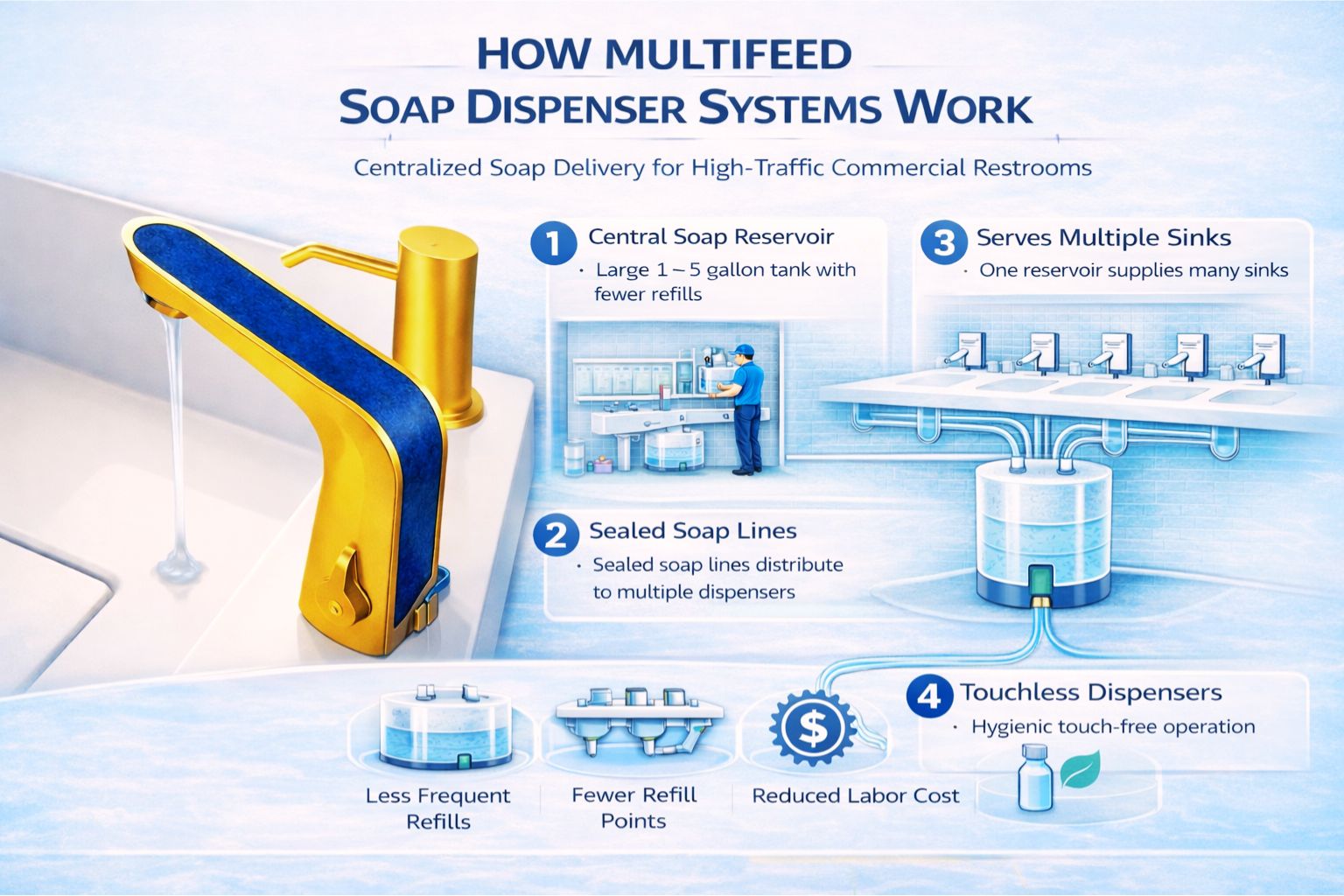
The challenge of multi-feed systems is addressed in multi-feed soap dispensers, which can serve numerous automated dispensers using one single bulk tank. Rather than servicing all the units separately, such as in the multi-feed systems, the servicing of one single bulk tank services all of the sink zones. Properly organized, it increases uptime, saves labor, and enables cleaner countertops.
Working definition
In this article, a multi-feed soap dispenser system refers to a centralized soap supply configuration where:
- One bulk reservoir supplies multiple automatic dispensers
- Dispensers draw soap through dedicated distribution tubing
- Refill occurs at a single service point
- Individual cartridges are eliminated
This configuration is different from informal bulk refill bottles. Multi-feed systems are engineered commercial solutions designed for repeatable performance and controlled maintenance.
Typical applications for multi-feed systems
Multi-feed systems are most often specified in restrooms with:
- Long countertop or wall mounted sink runs
- High daily handwashing volume
- Dedicated maintenance staff
- Design intent that favors minimal visible accessories
Common building types include:
- Airports and transit facilities
- Stadiums and arenas
- Universities and K-12 campuses
- Hospitals and outpatient facilities
- Convention centers
- Corporate headquarters with shared restrooms
System components and basic operation
Most commercial multi-feed systems include:
- A high capacity soap reservoir, typically 3 L to 10 L
- A fill port or top fill access point
- Distribution tubing feeding each dispenser
- Pumping mechanism, either centralized or integrated at each dispenser
- Check valves to prevent backflow and dripping
- Visual or electronic level indication
Category and system references:
https://www.bradleycorp.com/product/multi-feed-soap-system
https://www.bobrick.com/product/b-820/
https://thesplashlabusa.com/Multi-feed-Soap-System.dmx
Depending on manufacturer design, a single reservoir may supply six to ten dispensers or more.
Why multi-feed systems are specified in commercial restrooms
Reduced maintenance labor
Servicing one reservoir instead of multiple cartridges reduces refill time and lowers the chance of missed dispensers. This is especially valuable in facilities with hundreds of fixtures.
More consistent soap availability
All connected dispensers are replenished at the same time. This prevents uneven soap availability along a sink run.
Cleaner visual integration
Because the soap is not local, the soap dispenser does not grow larger in size. This facilitates contemporary restroom design, which avoids clutter.
Predictable operations
The centralized refill service ensures easier inventory management and facilitates planned maintenance, as opposed to the conventional refill technique.
Common multi-feed layout strategies
Under counter reservoir with top fill access
The reservoir is located inside the vanity or cabinet, with refill access from above or through a service panel. This is the most common approach in commercial interiors.
Remote reservoir in service space
In some installations, the reservoirs are placed in janitor closets and service chases. In such a case, the pathways of the tubes must be carefully routed.
Mixed dispenser mounting types
Certain systems offer both deck mounting as well as wall mounting options using one reservoir. Compatibility needs verification, especially in the dispensing of foams and liquids.
Engineering factors that affect performance
Reservoir sizing
Proper sizing depends on:
- Number of connected dispensers
- Estimated dispenses per basin per day
- Dose size per activation
- Soap type and viscosity
- Maintenance service frequency
Oversized reservoirs reduce refill frequency but increase the importance of proper cleaning and refill procedures.
Tubing routing and protection
Tubing failures are a common source of system issues.
Coordination items include:
- Manufacturer maximum tubing length
- Avoidance of sharp bends and pinch points
- Protection at casework penetrations
- Clear labeling for future maintenance
- As built diagrams at closeout
Pump behavior and priming
Inconsistent dispensing is immediately noticeable to users.
Commissioning checks should verify:
- All lines are fully primed
- Dose volume is consistent across dispensers
- No delay at the furthest dispenser
- No dripping after shutoff
Soap compatibility
Bulk soaps vary significantly in chemistry and viscosity.
Confirm the following before specification:
- Approved soap types
- Foam versus liquid compatibility
- Alcohol or sanitizer compatibility if required
- Tubing and seal chemical resistance
- Owner commitment to standardized soap selection
Unverified soap substitutions are a common cause of failure.
Hygiene and contamination considerations
Centralized reservoirs are not equivalent to informal bulk refill bottles, but refill protocol still matters. Research has shown that open refillable bulk soap systems can become contaminated if cleaning and refill practices are inconsistent.
Peer reviewed research:
https://journals.asm.org/doi/10.1128/AEM.02632-10
https://www.sciencedirect.com/science/article/pii/S0362028X22084575
Implications for specifiers:
- Avoid designs that encourage topping off without cleaning
- Require documented refill and cleaning procedures
- Coordinate with infection control policies in healthcare facilities
- Prefer closed reservoirs with controlled access
Hand hygiene context:
https://www.cdc.gov/clean-hands/hcp/clinical-safety/index.html
Design integration checklist for specifiers
Schematic design
- Confirm dispenser mounting type
- Confirm owner preference for centralized refill
- Identify maintenance access strategy
Design development
- Coordinate reservoir location with casework
- Confirm tubing routing paths
- Confirm power strategy for automatic dispensers
- Confirm soap type and compatibility
- Specify level indication if required
Construction documents
- Include system diagrams
- Require tubing length limits in submittals
- Include priming and commissioning requirements
Closeout
- Deliver as built diagrams
- Provide refill and cleaning procedures
- Identify replacement tubing and fittings
- Confirm facilities staff understanding of service requirements
When multi-feed systems are appropriate
Well suited for:
- High traffic public restrooms
- Long sink runs
- Facilities with full time maintenance staff
- Projects prioritizing uptime and appearance
Less suitable for:
- Small restrooms with low usage
- Facilities without maintenance capacity
- Projects with frequent soap changes
Example basis of design references
Bradley multi-feed soap systems
https://www.bradleycorp.com/product/multi-feed-soap-system
Bobrick bulk soap dispensing system
https://www.bobrick.com/product/b-820/
Splash Lab multi-feed system
https://thesplashlabusa.com/Multi-feed-Soap-System.dmx
American Specialties soap dispenser categories
https://americanspecialties.com/product_category/soap-dispensers/
Sloan commercial washroom accessories
https://www.sloan.com/products/faucets
Conclusion
Multi-feed soap dispenser systems support reliable soap availability, reduced maintenance effort, and cleaner restroom layouts when they are designed as coordinated systems. Performance depends on reservoir sizing, tubing layout, pump behavior, soap compatibility, and clear refill procedures. For AEC teams, treating soap dispensing as part of the overall plumbing and casework strategy leads to more predictable operation and better long term outcomes in commercial restrooms.
No responses yet