For
CommercialSoapDispenserAuto.com
Mounting Options: Deck-Mount, Wall-Mount, Recessed & Countertop in Heavy-Use Areas
In high traffic restrooms, touch free soap dispensers fail most often for predictable reasons: poor service access, splash and residue reaching the sensor, false activation from reflections, and mounting that loosens over time. Mounting choice is the first control point for all of these issues because it determines where hands naturally go, what the sensor can “see,” and how maintenance staff refills and cleans the unit.
Accessibility also matters. ADA protruding object limits apply when accessories project into circulation paths, which affects many surface mounted wall installations. The Access Board guide explains that objects with leading edges between 27 inches and 80 inches above the floor are limited to 4 inches maximum protrusion into circulation paths.
This guide compares deck mount, wall mount, recessed, and countertop placements for heavy use environments such as airports, campuses, arenas, healthcare, and transit.
Working definition
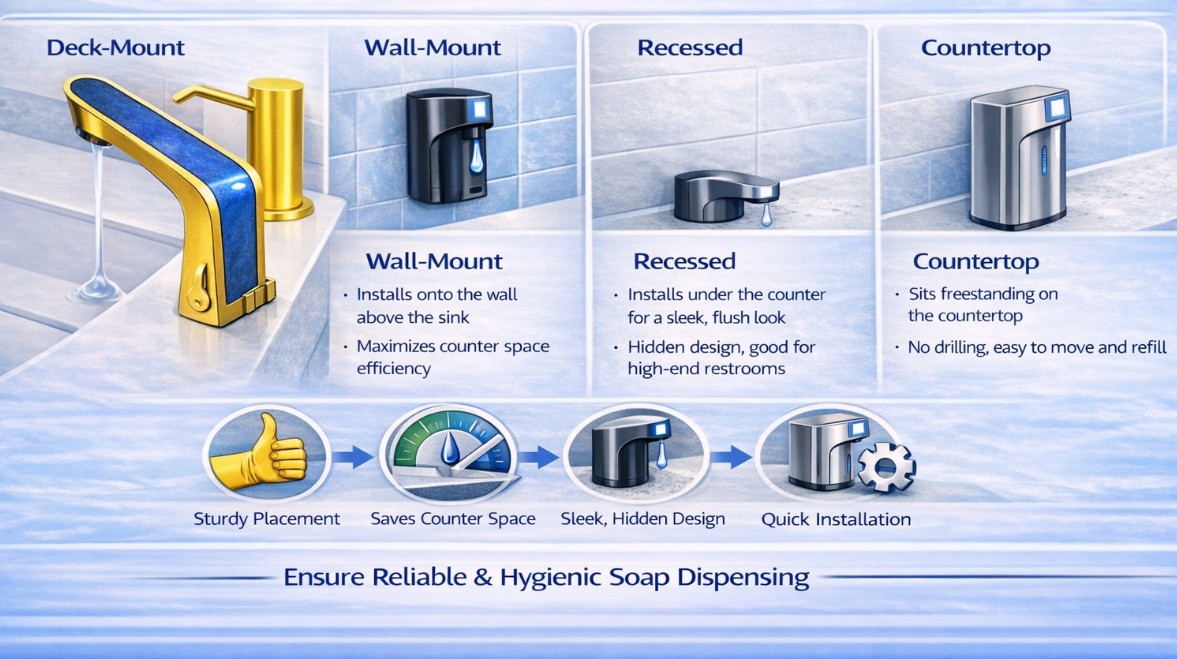
Deck mount means the dispenser spout and sensor are installed through the countertop or lav deck, often with a refill bottle or tank below the counter.
Wall mount means the dispenser is surface mounted on the wall above the sink.
Recessed means the dispenser body is installed into a wall opening so the face projects less into the room, often to reduce protrusion and improve durability.
Countertop placement in heavy use areas usually means a deck mounted commercial unit. Loose countertop sitting dispensers are typically a poor fit for public restrooms because they are easy to move, steal, or knock over.
AEC decision framework for heavy use areas
Before choosing a mounting type, align on five site conditions:
- Sink zone geometry (basin depth, counter setback, backsplash height, mirror location)
- Splash and cleaning exposure (spray patterns, disinfectant routines, fogging risk)
- Service access (refill frequency, under counter clearance, keying and locks)
- Abuse risk (vandalism, carts, bags, crowding, leaning)
- Accessibility and protrusion risk in the circulation path
Bobrick’s accessible restroom planning guide notes soap dispenser mounting height and also calls out protrusion limits, advising recessed accessories to eliminate protrusion compliance issues.
Option 1: Deck mount in heavy use restrooms
Where deck mount works best
Deck mount is a strong choice when you want the dispense point directly over the basin bowl, coordinated with the faucet, and protected from wall impact. It is common in airports, hospitality, and premium office restrooms where counters are robust and under counter space is available.
Advantages
- Dispense point can be centered over the bowl, reducing soap on the deck
- Less chance of protruding object issues in circulation paths compared to wall mounted accessories
- Easier to coordinate with integrated sink and faucet systems
Common failure points
- Under counter bottles are harder to access if casework is tight
- Sensor performance can be sensitive to countertop reflectivity and clearance
- Kinked tubes and strained connections when bottles are moved during refills
Clearance and reflectivity are not optional
Many commercial decks and counters are reflective. Some installation guides specify different minimum clearances depending on counter reflectivity. One Bradley related installation guide notes a minimum distance between the bottom of the dispenser and countertop and differentiates between non reflective and metal or reflective countertops.
Also, certain sensor models have minimum sensor clearance requirements and cannot be mounted directly on a deck without spacers or specific conditions. A manual excerpt for Verge series dispensers states that some series cannot be mounted directly on a deck due to required minimum sensor clearance and must be mounted over a lav bowl.
Specifier notes for deck mount
- Require a defined minimum sensor clearance over the deck or bowl based on manufacturer guidance
- Detail under counter service access and bottle change clearance
- Coordinate sensor line of sight so it does not “see” moving faucet water or reflective backsplash surfaces
Option 2: Wall mount in heavy use restrooms
Where wall mount works best
Wall mount is common in schools, stadiums, and retrofits because it avoids drilling stone counters and can be installed on standard partitions or tiled walls. It also keeps the refill body visible and accessible in some models.
Advantages
- Works well when under counter space is limited
- Simplifies retrofit work when counters cannot be modified
- Can keep dispenser away from direct splash if placed correctly
Risks and constraints
Protruding object compliance
Wall mounted accessories can create protruding object issues if they project more than allowed into a circulation path. The Access Board guide explains the 4 inch protrusion limit for objects between 27 inches and 80 inches above the floor.
Bobrick’s planning guide repeats the same principle and suggests using recessed accessories to eliminate protrusion compliance issues when units would project more than 4 inches.
Mounting height and reach
Bobrick’s accessible restroom planning guide states soap dispenser mounting height is 44 inches maximum above the finish floor.
Structural anchorage
Heavy use wall mount dispensers fail when backing is inadequate. Include blocking and proper anchors for tile, masonry, or stud walls. High abuse restrooms should assume lateral loading from bags and leaning.
Specifier notes for wall mount
- Confirm protrusion into circulation paths and use alcoves or recessed mounting when needed
- Set mounting height consistent with accessibility guidance and owner standards
- Detail blocking and substrate requirements
- Locate the dispense point so soap lands over the bowl, not onto the deck
Option 3: Recessed mounting for durability and compliance
Where recessed works best
Recessed mounting is often the best fit in corridors adjacent to restrooms, narrow sink zones, and high risk vandal locations where protrusion and impact are common. It is also a common solution when code review focuses on protruding objects.
Advantages
- Reduced projection into the circulation path, lowering protrusion risk
- Better protection from carts, crowding, and incidental impact
- Cleaner visual lines for architectural interiors
Tradeoffs
- Requires wall depth and coordination with plumbing, electrical, and blocking
- Needs water management detailing so moisture does not migrate into wall cavities
- Refill access must be designed so staff can service without damaging finishes
Specifier notes for recessed
- Coordinate rough opening early with studs, tile backing, and any waterproofing layers
- Confirm that the refill method is practical for janitorial workflows
- Use recessed assemblies when protrusion or high impact is a known risk
Option 4: Countertop placed units in heavy use areas
In public and high traffic restrooms, loose countertop units are usually a poor choice. They are easy to move, tip, steal, or misplace during cleaning. They also tend to create soap on decks because users reposition them.
If a project still wants a “countertop” visual, a commercial deck mount is typically the correct approach because it anchors the unit and controls the dispense zone.
Heavy use area selection guide
Airports and arenas
- Prefer deck mount or recessed wall mount
- Prioritize refill efficiency and sensor stability
- Use robust anchorage and serviceable under counter access
K 12 schools and transit
- Prefer recessed when possible for abuse resistance
- If wall mount is used, verify protrusion and protect edges
- Standardize locks and keys across the building
Healthcare
- Focus on sealed refill strategies and easy wipe down surfaces
- Avoid placements that lead to splash and residue on the sensor window
- Keep service access simple to support rapid rounds
Commissioning checklist for mounting success
Do not stop at “it dispenses once.” Validate real world behavior:
- First attempt activation with normal hand approach at each sink position
- No dispense when hands are outside the bowl zone
- No nuisance activation from pass by traffic
- No activation caused by faucet water stream in the sensor view
- Soap lands over the basin bowl and does not drip onto the deck
- Refill access can be done without tools that damage finishes
- Mounting remains rigid under light lateral load
Use manufacturer minimum clearance guidance where applicable, especially for deck mount sensors over reflective counters.
Conclusion
Deck mount, wall mount, recessed, and countertop strategies each succeed when they match sink geometry, service access, and the environmental conditions that drive sensor reliability. In heavy use areas, the most repeatable outcomes come from controlling the dispense zone over the basin, minimizing splash and reflections in the sensor field, providing robust anchorage, and addressing ADA protrusion limits early. When protrusion or impact risk is high, recessed mounting is often the simplest way to reduce both compliance risk and long term damage.
Supporting References
ADA protruding objects guide
https://www.access-board.gov/ada/guides/chapter-3-protruding-objects/
Access Board protruding objects PDF
https://beta.access-board.gov/files/ada/guides/protruding-objects.pdf
Bobrick Planning Guide for Accessible Restrooms, commercial PDF
https://www.bobrick.com/wp-content/uploads/APG-Accessible-Restrooms_Commercial.pdf
Bradley Verge deck mounted soap dispensers installation and maintenance manual PDF
https://media.bradleycorp.com/view/25688
Minimum sensor clearance note for certain Verge series dispensers
https://www.manualslib.com/manual/3431407/Watts-Bradley-Verge-Crestt-Series.html
Countertop reflectivity and minimum distance guidance (installation guide)
https://www.ameraproducts.com/Shared/ProductLitirature/Bradley_Corporation/6b1-119-3–4–installation-and-maintence-guide-amera.pdf
No responses yet