For
CommercialSoapDispenserAuto.com
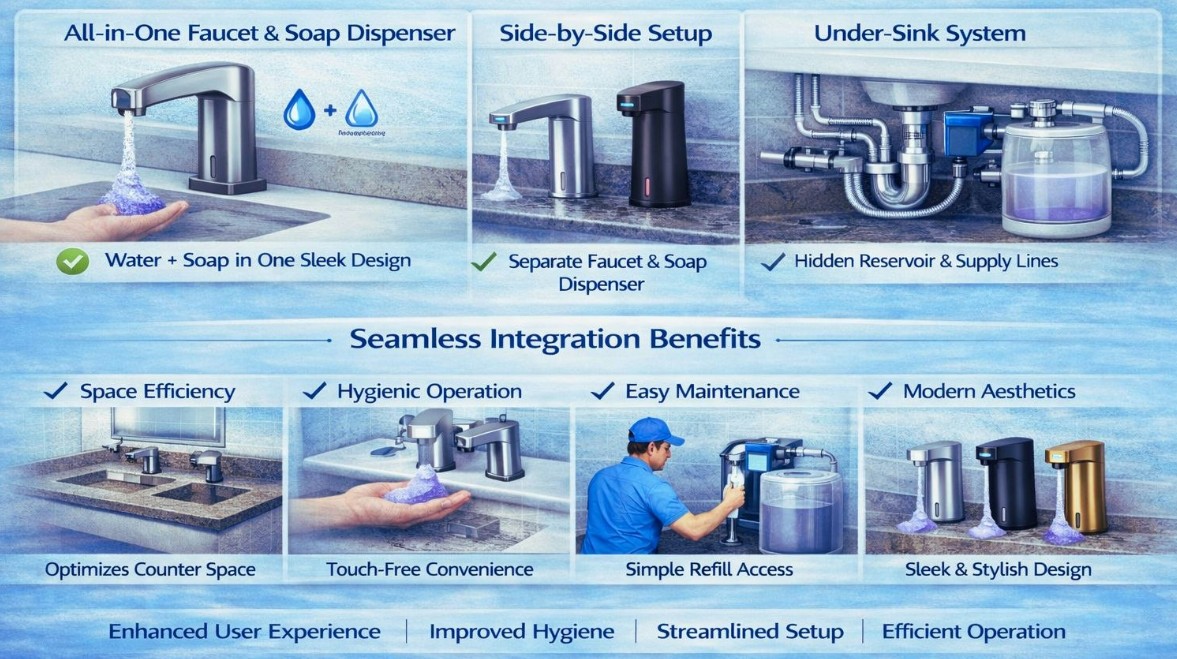
Integration of Automatic Soap Dispensers with Faucets and Sink Systems
In commercial restrooms, soap dispensers do not operate in isolation. They sit inside a small but complex system that includes the faucet, basin geometry, countertop depth, backsplash, mirror placement, lighting, power access, and the maintenance workflow. When these elements are not coordinated, the result is predictable: drips on counters, users reaching across water streams, nuisance sensor triggering, accessibility conflicts, and frequent service calls.
For AEC teams, the goal is a sink zone that supports hygiene, accessibility, durability, and maintainability with repeatable details across the project.
Working definition
In this article, integration means the soap dispenser, faucet, and basin are coordinated so that:
- Soap is dispensed within an easy reach zone at the sink
- The soap activation area does not interfere with faucet operation
- Water flow and splash do not foul the dispenser sensor window
- Accessories do not create protrusion hazards in circulation paths
- Power and refills are serviceable without removing casework
System types: what you are integrating
Automatic soap dispenser types
- Wall mounted surface units
- Wall recessed units
- Deck mounted units
- Multi-feed systems that supply multiple dispensers from one reservoir
Multi-feed system examples:
https://www.bradleycorp.com/product/multi-feed-soap-system
https://www.bobrick.com/product/b-820/
Faucet types that change the sink zone behavior
- Manual faucets
- Metering faucets
- Sensor activated faucets
WaterSense at Work provides commercial guidance on faucets and operational factors that affect real water use and performance in facilities:
https://www.epa.gov/system/files/documents/2023-06/ws-commercial-watersense-at-work_Section_3.3_Faucets.pdf
Integration priorities for architects and specifiers
1) Keep soap and water sequencing intuitive
Users typically expect a simple sequence:
- Dispense soap
- Wet hands
- Rinse
Common integration failures:
- Dispenser mounted too far from the basin so users drip across the counter
- Dispenser positioned so users must reach through the faucet stream
- Sensor faucet triggering while the user is dispensing soap
A practical rule in layouts:
- Place the dispenser so soap can be dispensed with hands centered over the basin, not over the counter edge
Bobrick’s planning guide notes that lavatory-mounted soap dispensers and lever-handle faucets should be spaced to avoid interference:
https://www.bobrick.com/wp-content/uploads/APG-Accessible-Restrooms_Commercial.pdf
2) Coordinate reach ranges and accessible use at the sink
Soap dispensers are treated as operable parts in accessible sink areas. The Access Board lavatories and sinks technical guide states that faucet controls, soap dispensers, and other manually operated elements must be usable with one hand and not require tight grasping, pinching, or twisting of the wrist, and not require more than 5 lbf to operate:
https://www.access-board.gov/files/ada/guides/lavs-sinks.pdf
Practical design approach:
- Measure to the operable portion of the dispenser, such as the sensor activation zone
- Avoid placing dispensers beyond reach over deep counters
- Keep staff-only locks and refill actions accessible for maintenance without making user operation difficult
Many commercial planning guides also use conservative mounting targets to reduce reach disputes. Bobrick lists a soap dispenser mounting height of 44 inches maximum above finished floor:
https://www.bobrick.com/wp-content/uploads/APG-Accessible-Restrooms_Commercial.pdf
3) Avoid protruding object problems in circulation paths
Wall mounted dispensers can create cane-detection hazards if they project too far into circulation routes. The protruding objects limit is a key checkpoint in restroom accessory placement.
Bobrick’s guide summarizes the common rule to limit protrusion to 4 inches maximum between 27 inches and 80 inches above the floor:
https://www.bobrick.com/wp-content/uploads/APG-Accessible-Restrooms_Commercial.pdf
Integration strategy:
- Use recessed dispensers in narrow entries, tight corridors, and pinch points
- Place projecting accessories in alcoves or between elements that keep them out of the main circulation path
4) Manage splash so sensors stay reliable and finishes stay clean
Soap dispenser sensors and faucet sensors both suffer when splash, soap mist, and mineral residue build up on windows and lenses. Splash also drives countertop staining and perceived cleanliness issues.
What to coordinate:
- Basin depth and slope relative to faucet outlet height
- Dispenser location relative to the most common splash zone
- Finish selections that tolerate frequent cleaning
Material and finish durability matters because aggressive cleaning is common in commercial restrooms. Stainless housings and vandal-resistant enclosures are often used in public restrooms for this reason:
https://www.vandalstop.com/vandal-resistant-soap-and-sanitizer-dispensers
5) Align sensor zones so they do not trigger each other
A common problem in touchless sink zones is cross-activation:
- A faucet triggers when the user reaches for soap
- A soap dispenser triggers when the user rinses hands
This is mostly a geometry and zoning issue. The sink zone should be planned so each sensor has a tight, intentional activation range.
Commissioning steps that reduce nuisance activation:
- Adjust sensing range to activate only where hands should be
- Verify performance under bright lighting and reflective countertop conditions
- Test with multiple user heights and typical hand positions
If the sink zone includes sensor faucets, real-world water use performance can vary based on run time settings and user behavior. The Alliance for Water Efficiency report on sensor-operated fixtures provides context on performance variability:
https://allianceforwaterefficiency.org/wp-content/uploads/2019/09/Sensor-Operated-Fixtures-Final-Report-March-2010.pdf
6) Integrate power and service access with the casework package
Automatic dispensers add a service layer. Even battery units require predictable access. Multi-feed units add tubing routing and reservoir access.
Casework coordination items:
- Provide access for battery changes without removing mirrors or panels
- Keep refill access clear of trap arms and plumbing clutter
- Provide labeled tubing paths for multi-feed systems
- Avoid routing tubes across sharp edges or drawer hardware
Multi-feed references:
https://www.bradleycorp.com/product/multi-feed-soap-system
https://www.bobrick.com/product/b-820/
Brand tiers: premium, institutional, and budget integration realities
Premium commercial and institutional systems
These often integrate better because they provide:
- More consistent mounting templates
- Better service documentation
- Locking covers and tamper resistance options
- Predictable refill and maintenance workflows
Commercial category references:
https://americanspecialties.com/product_category/soap-dispensers/
https://www.bobrick.com/product/b-820/
Institutional sealed refill ecosystem reference:
https://www.gojo.com/en/product-catalog/productdetail?sku=1920-04
Mid-range and prosumer systems
These can work in boutique offices and moderate-traffic spaces, but integration challenges often show up in:
- Limited mounting documentation
- Smaller reservoirs and more frequent refills
- Higher sensitivity to lighting and reflections
Prosumer spec sheet example:
https://www.webstaurantstore.com/documents/specsheets/simplehuman_st1500_pump_spec_sheet.pdf
Budget and retail systems
Budget units may be fine for low-use spaces, but AEC integration issues commonly include:
- Limited published sensing range
- Mounting plates that loosen under heavy use
- Weak finish durability under disinfectants
- Higher false-trigger risk in reflective interiors
Independent consumer testing references:
https://www.epicurious.com/shopping/best-automatic-soap-dispensers
https://www.consumerreports.org/home-garden/best-automatic-soap-dispensers-a8957567205/
Hygiene and refill method: integration includes the operations plan
If the system uses bulk refill, the refill protocol becomes part of the integration scope. Research has shown open refillable bulk soap systems can be prone to extrinsic contamination when practices are inconsistent.
Peer-reviewed research:
https://journals.asm.org/doi/10.1128/AEM.02632-10
https://www.sciencedirect.com/science/article/pii/S0362028X22084575
Design implication for AEC teams:
- If bulk refill is specified, include a documented cleaning and refill procedure in closeout
- Consider sealed refills in infection-control sensitive environments when owner policy requires it
Hand hygiene context:
https://www.cdc.gov/clean-hands/hcp/clinical-safety/index.html
Coordination checklist: faucet, dispenser, basin, and accessories
Layout and reach
- Soap dispenser operable portion within reach at the accessible lavatory
- Dispenser positioned so users dispense soap over the basin
- Dispenser and faucet spaced to prevent interference
References:
https://www.access-board.gov/files/ada/guides/lavs-sinks.pdf
https://www.bobrick.com/wp-content/uploads/APG-Accessible-Restrooms_Commercial.pdf
Splash and cleanliness
- Basin depth and faucet outlet height coordinated to reduce splash
- Dispenser sensor window placed outside the primary splash zone
- Finish and lens cleaning compatibility confirmed
Sensors
- Soap sensor and faucet sensor zones do not overlap
- Commission sensing ranges under real lighting conditions
- Confirm no false activation from mirror glare or reflective counters
Maintenance
- Battery replacement access without dismantling casework
- Clear refill access and spill containment plan
- Multi-feed tubing protected and labeled with as-built diagrams
Example basis-of-design references
ADA lavatories and sinks technical guide (soap dispensers and faucet controls as operable parts):
https://www.access-board.gov/files/ada/guides/lavs-sinks.pdf
Bobrick accessible restroom planning guide (mounting height and interference notes):
https://www.bobrick.com/wp-content/uploads/APG-Accessible-Restrooms_Commercial.pdf
WaterSense at Work commercial faucets guidance:
https://www.epa.gov/system/files/documents/2023-06/ws-commercial-watersense-at-work_Section_3.3_Faucets.pdf
Sensor-operated fixtures field performance research:
https://allianceforwaterefficiency.org/wp-content/uploads/2019/09/Sensor-Operated-Fixtures-Final-Report-March-2010.pdf
Multi-feed system references:
https://www.bradleycorp.com/product/multi-feed-soap-system
https://www.bobrick.com/product/b-820/
Commercial soap dispenser category page:
https://americanspecialties.com/product_category/soap-dispensers/
Institutional sealed refill reference:
https://www.gojo.com/en/product-catalog/productdetail?sku=1920-04
Bulk refill contamination research:
https://journals.asm.org/doi/10.1128/AEM.02632-10
https://www.sciencedirect.com/science/article/pii/S0362028X22084575
Conclusion
Integrating automatic soap dispensers with faucets and sink systems is a coordination task that affects accessibility, hygiene perception, and maintenance cost. The most reliable commercial sink zones keep soap dispensing within reach, avoid interference with faucet operation, control splash that degrades sensors, and provide service access that does not require dismantling casework. When these details are standardized early, sink areas perform consistently across the building and remain easier to maintain over the life of the facility.
Supporting References
https://www.access-board.gov/files/ada/guides/lavs-sinks.pdf
https://www.bobrick.com/wp-content/uploads/APG-Accessible-Restrooms_Commercial.pdf
https://www.epa.gov/system/files/documents/2023-06/ws-commercial-watersense-at-work_Section_3.3_Faucets.pdf
https://allianceforwaterefficiency.org/wp-content/uploads/2019/09/Sensor-Operated-Fixtures-Final-Report-March-2010.pdf
https://www.bradleycorp.com/product/multi-feed-soap-system
https://www.bobrick.com/product/b-820/
https://americanspecialties.com/product_category/soap-dispensers/
https://www.gojo.com/en/product-catalog/productdetail?sku=1920-04
https://journals.asm.org/doi/10.1128/AEM.02632-10
https://www.sciencedirect.com/science/article/pii/S0362028X22084575
https://www.cdc.gov/clean-hands/hcp/clinical-safety/index.html
https://www.vandalstop.com/vandal-resistant-soap-and-sanitizer-dispensers
No responses yet