For
CommercialSoapDispenserAuto.com
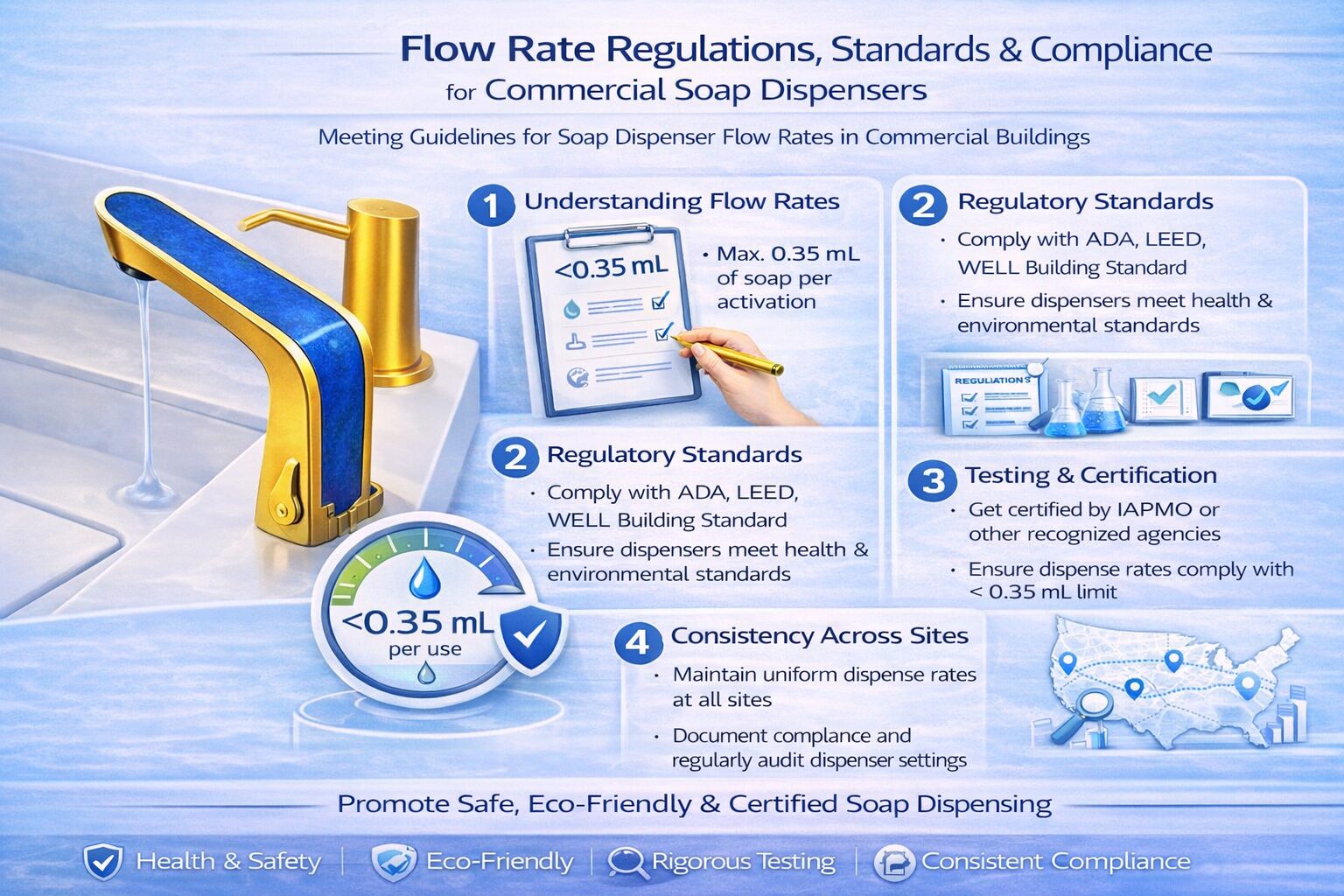
Flow Rate Regulations, Standards & Compliance for Commercial Soap Dispensers
In commercial washrooms, the word “flow rate” usually applies to faucets. For soap dispensers, there is rarely a single universal code limit on how much soap must dispense per activation. Instead, compliance is driven by a combination of accessibility rules (mounting height, reach, protrusion), infection control requirements (sealed refills versus open bulk), and safety codes when alcohol based hand rub is part of the same dispenser family or installed nearby in the same corridor.
For AEC teams, the practical goal is to specify soap dispensing performance in a measurable way, then document placement and servicing so it holds up across real use and multi site maintenance.
What “flow rate” means for soap dispensers
In specifications, soap “flow rate” is best treated as one of these measurable outputs:
- Output per activation (dose volume or dose mass)
- Dispense time per activation (pump on time)
- Output per stroke for manual pumps (measured quantity per actuation)
A useful reference method for quantifying output per stroke is ASTM D4336, which is intended to measure the mean quantity dispensed per actuation from a mechanical pump dispenser and can be used to establish dosage and package specifications. https://standards.globalspec.com/std/13000073/astm-d4336-18
Why it matters for commercial projects:
- Under dosing can reduce user satisfaction and increase repeat triggering
- Over dosing increases consumption, creates mess on counters, and raises maintenance labor
- Unmeasured “it seems fine” performance does not scale across buildings
The compliance reality: most “rules” are about placement and safety, not dose volume
1) ADA protruding object limits for wall mounted dispensers
If a dispenser is installed on a wall along a circulation path, protrusion limits can apply. The ADA Standards limit protrusion to 4 inches maximum when the leading edge is between 27 inches and 80 inches above the floor. This is a common driver for recessed mounting or careful placement outside circulation paths.
https://www.access-board.gov/ada/guides/chapter-3-protruding-objects/
https://www.corada.com/documents/2010ADAStandards/307
Practical implication:
- In tight restrooms, a high capacity surface mounted dispenser can be a compliance problem even if it is functionally excellent.
2) ADA operable parts and reach ranges
Touch free dispensers reduce user operation, but there are still operable parts and reach considerations in many designs (locks, buttons, access doors). The Access Board operable parts guidance explains how the standards address operable parts and usability.
https://www.access-board.gov/ada/guides/chapter-3-operable-parts/
Practical implication:
- If a unit has a user facing button, override, or similar operable control, placement should not assume “touch free” means “no reach concerns.”
3) WELL certification hygiene requirements can drive sealed refill selection
WELL v2 includes a hand washing feature section that specifies liquid soap in dispensers with disposable and sealed soap cartridges as part of contamination reduction.
https://standard.wellcertified.com/v2/nourishment/hand-washing
Practical implication:
- For projects targeting WELL, open bulk top off systems may not align with the intended approach for contamination reduction.
Infection control and why bulk refill practices affect compliance narratives
Even when a building code does not regulate soap dose, owners and auditors increasingly evaluate hygiene risks and operational controls.
Peer reviewed research in Applied and Environmental Microbiology reports that bulk soap refillable dispensers are prone to extrinsic bacterial contamination and the study quantified contamination and transfer after washing with contaminated soap.
https://journals.asm.org/doi/10.1128/aem.02632-10
A separate study in Food Control discusses microbial quality concerns and contamination risks in open refillable bulk soap in food service contexts.
https://www.sciencedirect.com/science/article/pii/S0362028X22084575
Practical implication for specs:
- If a project uses bulk refill systems, include a no top off policy and cleaning protocol in O and M deliverables.
- If a project needs stronger contamination controls, specify sealed cartridge systems and document it as an infection control decision.
Fire code and safety compliance when sanitizer dispensing is part of the same washroom program
Many commercial washroom programs include both soap dispensers at sinks and alcohol based hand rub dispensers in corridors, entries, or nurse stations. Those sanitizer dispensers do have code driven limits that are often reviewed by AHJs and accreditation bodies.
The Joint Commission FAQ summarizes NFPA 101 Life Safety Code related limits and installation conditions for alcohol based hand rub dispensers in corridors, including maximum individual dispenser capacity and spacing conditions.
https://www.jointcommission.org/en-us/knowledge-library/support-center/standards-interpretation/standards-faqs/000001560
CDC also provides guidance on fire safety considerations for alcohol based hand sanitizer storage and dispensers in healthcare facilities.
https://www.cdc.gov/clean-hands/media/pdfs/cdc-abhs-firesafety-508.pdf
Practical implication:
- If your dispenser schedule includes sanitizer units, coordinate early with fire safety and confirm the governing code edition used by the local AHJ.
Standards and documentation that support measurable dispensing performance
ASTM based measurement language for manual pumps
If you need measurable output per actuation language, ASTM D4336 is a common reference point for how output per stroke is determined for pump dispensers.
https://standards.globalspec.com/std/13000073/astm-d4336-18
How to use this in a spec without turning it into a product ad:
- Require the manufacturer to provide dose output per actuation in mL or grams.
- Require tolerances for output consistency and a method of verification.
Manufacturer support documents for settings and troubleshooting
Manufacturer troubleshooting documents can be used as “support documents” in closeout to reduce service calls and to define expected behavior.
Example: Bobrick B 828 troubleshooting guide includes symptom based fixes and references nozzle tip mesh and other components that affect dispensing performance and foam quality.
https://www.bobrick.com/wp-content/uploads/TSG-B-828.pdf
Example: GOJO LTX troubleshooting guide describes sensor and calibration behavior, which affects commissioning and maintenance expectations.
https://cdnimg.webstaurantstore.com/documents/pdf/ltx_-_troubleshooting_guide.pdf
What to put in the specification: performance, placement, and compliance in one checklist
A) Dispensing performance
- Dose output per activation stated in measurable units (mL or grams)
- Dispense time per activation stated if the unit is programmable
- Foam versus liquid compatibility clearly stated
- Expected refill interval targets for high traffic zones
B) Accessibility and placement compliance
- Wall mounted dispensers checked for protrusion risk in circulation paths (4 inch limit in the 27 to 80 inch zone)
https://www.access-board.gov/ada/guides/chapter-3-protruding-objects/
https://www.corada.com/documents/2010ADAStandards/307 - Operable parts and access doors placed to support reachable servicing and intended user access where applicable
https://www.access-board.gov/ada/guides/chapter-3-operable-parts/
C) Hygiene and refill system controls
- If WELL is targeted, specify sealed disposable cartridges for liquid soap where required
https://standard.wellcertified.com/v2/nourishment/hand-washing - If bulk refill is used, include a no top off policy and cleaning procedure supported by contamination research context
https://journals.asm.org/doi/10.1128/aem.02632-10
D) Safety codes where sanitizer is included
- Corridor sanitizer units coordinated with NFPA and local code requirements and spacing rules
https://www.jointcommission.org/en-us/knowledge-library/support-center/standards-interpretation/standards-faqs/000001560
https://www.cdc.gov/clean-hands/media/pdfs/cdc-abhs-firesafety-508.pdf
Category page links for spec discovery and system coordination
These help AEC teams compare mounting types, refill architectures, and coordinated faucet plus soap systems:
https://www.bobrick.com/product-catalog/categories/soap-dispensers-faucets/
https://www.bradleycorp.com/product-category/soap-dispenser
https://americanspecialties.com/product_category/soap-dispensers/
Conclusion
Commercial soap dispensers are not typically governed by a single dose “flow rate” code in the way faucets are governed by gpm limits. Compliance is mostly driven by accessibility placement rules, hygiene program requirements such as sealed refills in WELL, and safety rules when sanitizer dispensers are part of the same restroom and corridor strategy. The most reliable AEC approach is to specify dispensing output as a measurable performance target, then document mounting and service access so the performance stays consistent across heavy use conditions and multi site maintenance.
Supporting References
ADA protruding objects guidance
https://www.access-board.gov/ada/guides/chapter-3-protruding-objects/
https://www.corada.com/documents/2010ADAStandards/307
ADA operable parts guidance
https://www.access-board.gov/ada/guides/chapter-3-operable-parts/
WELL v2 hand washing feature library
https://standard.wellcertified.com/v2/nourishment/hand-washing
Peer reviewed research on bulk refill contamination
https://journals.asm.org/doi/10.1128/aem.02632-10
https://www.sciencedirect.com/science/article/pii/S0362028X22084575
ASTM output per stroke reference summary
https://standards.globalspec.com/std/13000073/astm-d4336-18
Sanitizer dispenser fire safety references
https://www.jointcommission.org/en-us/knowledge-library/support-center/standards-interpretation/standards-faqs/000001560
https://www.cdc.gov/clean-hands/media/pdfs/cdc-abhs-firesafety-508.pdf
Troubleshooting and performance support documents
https://www.bobrick.com/wp-content/uploads/TSG-B-828.pdf
https://cdnimg.webstaurantstore.com/documents/pdf/ltx_-_troubleshooting_guide.pdf
Category pages
https://www.bobrick.com/product-catalog/categories/soap-dispensers-faucets/
https://www.bradleycorp.com/product-category/soap-dispenser
https://americanspecialties.com/product_category/soap-dispensers/
No responses yet