For
CommercialSoapDispenserAuto.com
Vandal Resistance, Tamper Proofing, and Locking Mechanisms in Public Restrooms
Public restrooms create a different design problem than private washrooms. The accessories are used by thousands of people, cleaned aggressively, and exposed to impacts, prying, and misuse. In this environment, soap dispensers, towel units, and grab bars fail less from normal wear and more from tampering, forced entry, and repeated abuse at doors, seams, and mounting points.
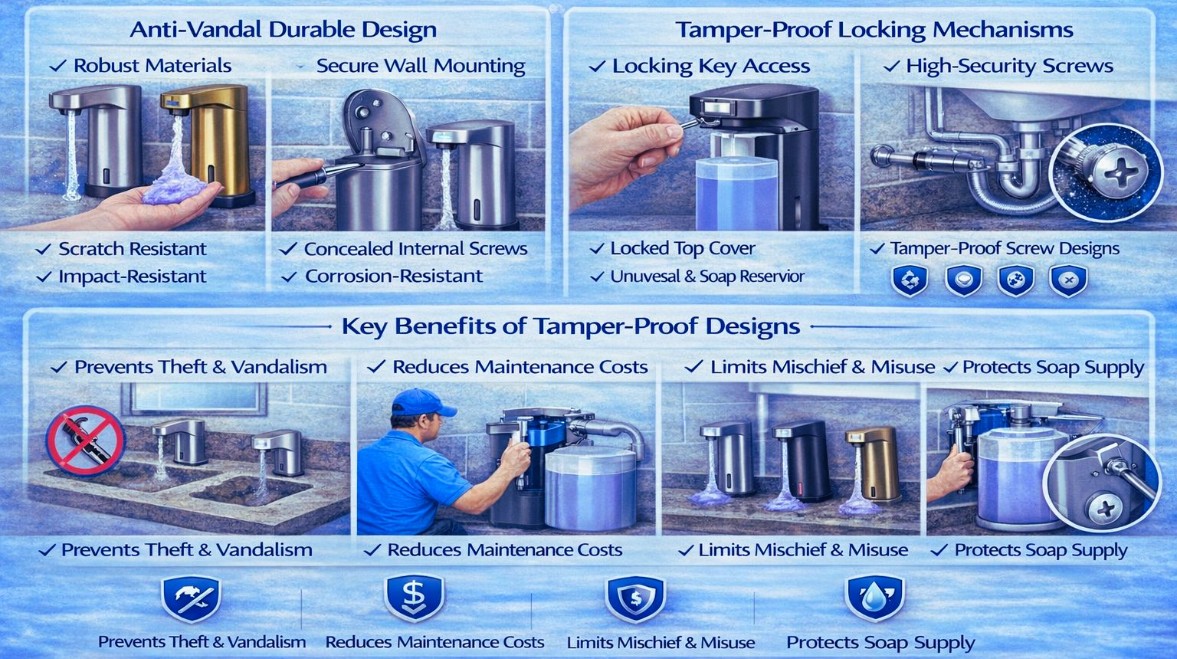
For AEC teams, vandal resistance is not a single feature. It is a set of coordinated decisions: material gauge, cover geometry, lock type, mounting substrate, and maintenance access. The best results come from designing the restroom as a system that discourages tampering while staying serviceable.
Working definition
In this article:
Vandal resistant means the accessory is designed to tolerate impacts, prying, and forced entry attempts without losing function or creating unsafe edges.
Tamper proofing means design features that discourage casual interference, such as concealed fasteners, protected seams, and restricted refill access.
Locking mechanism means the hardware that prevents unauthorized access to refills or internal components, such as tumbler locks, keyed cam locks, or specialty keys.
Public restroom means high traffic washrooms in airports, stadiums, schools, parks, transit facilities, and shared building cores.
Brand tiers: premium commercial vs budget in vandal exposure
Premium commercial and institutional systems
Spec-grade restroom accessories typically offer:
- Stainless steel housings
- Locking covers
- Serviceable internal parts
- Installation templates and submittal documentation
A manufacturer catalog is useful for identifying which products are built with locking covers and heavy duty enclosures across a complete accessory package.
https://www.bobrick.com/wp-content/uploads/RestroomAccessoryCatalog.pdf
Security focused and anti vandal product lines
Some suppliers focus specifically on anti vandal hardware, including heavy gauge stainless and protected lock areas.
https://www.vandalstop.com/
Budget and light duty systems
Consumer grade dispensers and low cost units often lack:
- Rigid housings that resist prying
- Protected lock cylinders
- Anchoring designed for concrete and masonry
- Published service parts and replacement lock support
For public restrooms, these gaps typically show up as frequent replacement and downtime.
Common abuse modes in public restrooms
A spec that says stainless steel is not enough. It helps to identify how fixtures fail in the field.
Prying at the cover seam
If the cover edge can be grabbed with a coin or flat tool, it will be. Strong seam geometry and lock protection matter as much as material.
Levering the unit off the wall
Many failures come from weak substrate anchoring or no blocking behind gypsum. The housing can survive, but the wall does not.
Lock attacks and key conflicts
Cheap locks fail quickly. Keying that is too common causes security issues. Keying that is too unique frustrates maintenance staff.
Sensor window damage
Touchless dispensers can fail from scratched lenses, residue, or impacts, which causes nuisance dispensing or no dispensing.
Materials that actually resist vandalism
Stainless steel gauge and enclosure rigidity
In vandal exposure, stiffness matters. Thin stainless can dent, crease, and deform at corners. Look for enclosure designs that are rigid around the door and lock face.
Anti vandal suppliers often emphasize heavier gauge stainless for restroom hardware.
https://www.vandalstop.com/
Reinforced plastic and composite housings
Plastic can work in controlled spaces, but it is often the first material to crack at hinge points, screw bosses, and latch tabs under abuse.
Concealed fasteners
Fasteners are targets. Concealed mounting plates, security screws, and internal access reduce casual removal.
Locking mechanisms used in restroom accessories
Tumbler locks
Common in commercial restroom accessories. They are typically simple and serviceable. A tumbler lock can be adequate if the cover seam is strong and the lock is protected from being twisted with tools.
Product catalogs often call out tumbler lock options for dispensers and related accessories.
https://www.bobrick.com/wp-content/uploads/RestroomAccessoryCatalog.pdf
Keyed cam locks
Used for access panels and refill doors. Performance depends on cylinder quality and how the cam engages the housing.
Specification tips:
- Require replaceable cylinders
- Require protected cylinder location
- Avoid designs where the lock is the only thing preventing prying
Specialty keys and security screw strategies
Security screw drives reduce tampering when the goal is to restrict access to authorized staff. The tradeoff is maintenance speed. If staff do not have the bit available, covers get forced.
Operational guideline:
- Standardize the key type and security screw drive across the building
- Include spare keys and bits in closeout documents
Example basis of design references
https://www.access-board.gov/ada/guides/chapter-3-protruding-objects/
https://www.bobrick.com/wp-content/uploads/RestroomAccessoryCatalog.pdf
https://www.vandalstop.com/
https://www.totalrestroom.com/products/bobrick-b-8226-commercial-soap-dispenser-surface-mounted-manual-push-stainless-steel
https://www.berls.com/blog/vandal-resistant-bathrooms
Conclusion
Vandal resistance in public restrooms is achieved through a combination of enclosure rigidity, protected seams, reliable locks, concealed fasteners, and correct wall anchoring. Locking mechanisms matter, but locks alone do not prevent failure if the housing can be pried or the wall can be leveraged. The strongest specifications standardize lock types for maintenance, coordinate backing and anchors for the substrate, and place accessories to avoid both vandal exposure and ADA protruding object hazards.
No responses yet