For
CommercialSoapDispenserAuto.com
Temperature, Humidity & Environmental Factors Affecting Sensor Soap Dispensers
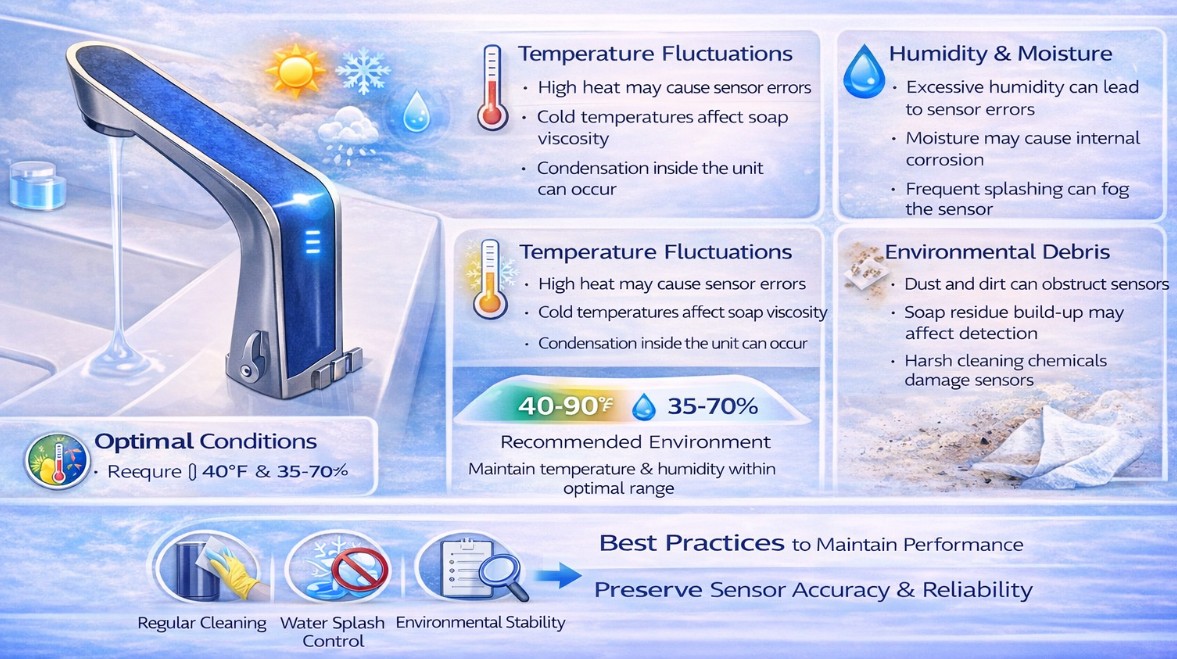
Sensor soap dispensers are often specified as simple touchless accessories, but their real performance depends on the restroom environment. Temperature swings can change soap viscosity and pump load. Humidity can push surfaces toward condensation and fogging. Splash and cleaning chemicals can leave films that change sensor response and dosing consistency.
For AEC teams, the best outcomes come from treating the dispenser as part of the sink zone system: lighting, air movement, splash patterns, soap chemistry, and maintenance access. Manufacturer guidance and sensor research both show that environmental variables can materially affect sensor accuracy and system behavior. https://www.sciencedirect.com/science/article/pii/S0021850220302007
Working definition
Temperature effect means changes in soap flow behavior, pump performance, and sensor stability when ambient conditions move outside normal indoor ranges.
Humidity effect means moisture-related issues such as fogging, condensation, residue tracking, and corrosion risk for contacts and fasteners.
Environmental factors include splash exposure, cleaning practices, airborne dust, and reflective surfaces that influence sensor triggering and dosing.
Temperature changes the soap first, not the sensor
Many performance complaints that look like “sensor failure” are actually soap flow problems.
Cold conditions increase viscosity and can cause congealing
When soap thickens, it moves slower through valves and spouts, increasing the chance of partial doses, slow recovery, and clogging.
A user manual notes that cold or dry weather and lack of use can lead to soap congealing in the spout or dispensing tube and recommends flushing with warm soapy water to clear it. https://www.thesecura.com/wp-content/uploads/Secura-Automatic-Soap-Dispenser-User-Manual.pdf
Soap viscosity and pH ranges matter for commercial systems
Bradley’s installation and maintenance manual gives specific viscosity and pH guidance for reliable operation and explains that thick soap reduces the flushing action of valves, allowing soap to congeal and clog. It also warns that improper dilution or corrosive soaps can cause valve failure and component degradation. https://media.bradleycorp.com/view/25688
AEC specification action:
- Require soap viscosity within the dispenser manufacturer’s recommended range.
- Prohibit using concentrates undiluted if dilution is required.
- Include a flushing and valve cleaning procedure in the O and M manuals.
Humidity and dew point drive condensation risk
High humidity by itself is not always the problem. The real issue is dew point. Condensation forms when a surface drops below the ambient dew point, even briefly.
Honeywell’s humidity sensor theory document explains that condensation occurs whenever the surface temperature of the active area drops below the ambient dew point and can form even if the surface temperature only momentarily dips below dew point. https://prod-edam.honeywell.com/content/dam/honeywell-edam/sps/siot/en-us/products/sensors/humidity-with-temperature-sensors/common/documents/sps-siot-009024-2-en-ciid-49925.pdf
How this shows up in restrooms:
- Cold water lines and chilled wall cavities can create cold surfaces near dispensers.
- Exterior wall restrooms can see rapid swings from warm humid air to cooler wall surfaces.
- Overnight HVAC setbacks can push surfaces into dew point conditions.
What condensation does to dispensers:
- Fogged sensor windows reduce detection reliability.
- Water films can refract IR and change trigger distance.
- Moisture can carry dust and soap residue into seams, increasing maintenance needs.
Design action:
- Avoid locating sensor windows in direct airflow from cold supply lines or diffusers where temperature gradients are sharp.
- Use backer and sealing details that minimize moisture intrusion behind wall plates in wet zones.
Humidity plus cleaners accelerates residue films and lens fouling
Even without visible condensation, humid environments help films build faster.
Typical sources of film:
- Soap mist and micro-spray from repeated dosing
- Aerosolized cleaners and disinfectants
- Splash rebound from shallow basins and high-pressure aerators
Bradley’s maintenance section recommends wiping finishes with mild neutral cleaners and drying with a soft cloth to avoid micro-scratches in the finish and sensor plate, and it also emphasizes periodic hot-water flushing to clear residue and prevent clogs. https://media.bradleycorp.com/view/25688
AEC specification action:
- Include a cleaning method that avoids abrasive pads on sensor plates and windows.
- Require basin and spout coordination so soap dispenses over the bowl, not into splash zones.
Battery and electronics reliability in humid restrooms
Many commercial dispensers are battery powered, and humid environments can create predictable weak points:
- Battery contact corrosion
- Moisture ingress around covers
- Reduced reliability if staff leaves covers open during service
GOJO documentation describes an auto-calibration period to surrounding lighting conditions after closing the cover, which reinforces the need for correct service practices and stable environmental conditions during reset. https://cdnimg.webstaurantstore.com/documents/pdf/ltx_-_troubleshooting_guide.pdf
Field planning actions:
- Ensure service access allows covers to close fully and consistently.
- Standardize battery replacement intervals for high-traffic zones to reduce reactive failures.
- Avoid mounting where water can drip directly onto the cover seam.
Installation geometry interacts with environment
Environmental issues are amplified when geometry is wrong.
Sensor clearance and basin placement
Bradley’s manual notes minimum sensor clearance requirements for certain deck-mounted dispensers and states that some series cannot be mounted directly on a deck due to minimum sensor clearance and must be mounted over a lav bowl. https://media.bradleycorp.com/view/25688
Why this matters for humidity and splash:
- Deck mounting too close to the bowl edge increases splash and film on the sensor plate.
- Mounting too far back moves the activation zone into the deck area, increasing drips and residue.
Commissioning check:
- Confirm first-attempt activation with hands positioned over the bowl.
- Confirm no activation when water stream is running if the dispenser has line-of-sight issues.
Environmental factors that create nuisance triggering
Temperature and humidity are often part of a larger set of factors that alter sensor stability.
Common triggers in real restrooms:
- Mirror reflections and glossy backsplash surfaces
- Moving water streams in the sensor field
- Shifting daylight patterns near windows
- Steam bursts near showers or locker rooms
Sensor research literature notes that temperature and humidity can affect sensor accuracy, and in many cases the effects are appreciable. https://www.sciencedirect.com/science/article/pii/S0021850220302007
Design action:
- Keep the sensor field aimed at the intended hand zone, not reflective backgrounds.
- Avoid placing dispensers directly opposite mirrors at close range.
- Test under both daytime and nighttime lighting conditions.
Specifier checklist for temperature and humidity resilience
A) Soap and dosing resilience
- Soap viscosity and pH requirements listed in the spec
- No undiluted concentrates if dilution is required
- Flushing and valve cleaning procedure included for cold-weather sites https://media.bradleycorp.com/view/25688
- Cold-condition congeal mitigation procedure for low-use restrooms https://www.thesecura.com/wp-content/uploads/Secura-Automatic-Soap-Dispenser-User-Manual.pdf
B) Condensation and moisture control
- Avoid cold-surface placements that push sensor windows below dew point
- Seal penetrations and use appropriate backers in wet zones
- Maintenance note on fogging and lens cleaning method https://prod-edam.honeywell.com/content/dam/honeywell-edam/sps/siot/en-us/products/sensors/humidity-with-temperature-sensors/common/documents/sps-siot-009024-2-en-ciid-49925.pdf
C) Maintenance and service behavior
- Train staff on cover closure and post-service behavior for calibrated units https://cdnimg.webstaurantstore.com/documents/pdf/ltx_-_troubleshooting_guide.pdf
- Require non-abrasive cleaning of sensor plates and finishes https://media.bradleycorp.com/view/25688
D) Placement and geometry
- Confirm minimum sensor clearances and mounting over the bowl where required https://media.bradleycorp.com/view/25688
Conclusion
Temperature, humidity, and environmental conditions affect sensor soap dispensers mainly through soap behavior, condensation risk, and residue films that change both sensor detection and dosing consistency. Cold conditions increase viscosity and can cause congealing. Humidity combined with dew point shifts can create fogging and moisture films. High humidity also accelerates residue buildup, especially when paired with aggressive cleaning practices. AEC teams can reduce callbacks by specifying soap properties within manufacturer limits, coordinating geometry so dispensing occurs over the bowl, detailing moisture control at penetrations, and including a realistic cleaning and flushing routine in closeout documentation. https://media.bradleycorp.com/view/25688
Supporting References
https://media.bradleycorp.com/view/25688
https://www.thesecura.com/wp-content/uploads/Secura-Automatic-Soap-Dispenser-User-Manual.pdf
https://prod-edam.honeywell.com/content/dam/honeywell-edam/sps/siot/en-us/products/sensors/humidity-with-temperature-sensors/common/documents/sps-siot-009024-2-en-ciid-49925.pdf
https://cdnimg.webstaurantstore.com/documents/pdf/ltx_-_troubleshooting_guide.pdf
https://www.sciencedirect.com/science/article/pii/S0021850220302007
https://www.bradleycorp.com/product-category/soap-dispenser
https://www.bobrick.com/product-catalog/categories/soap-dispensers-faucets/
https://americanspecialties.com/product_category/soap-dispensers/
No responses yet