For
CommercialSoapDispenserAuto.com
Service Access & Power Routing: Best Practices for Multi-Site Commercial Restrooms
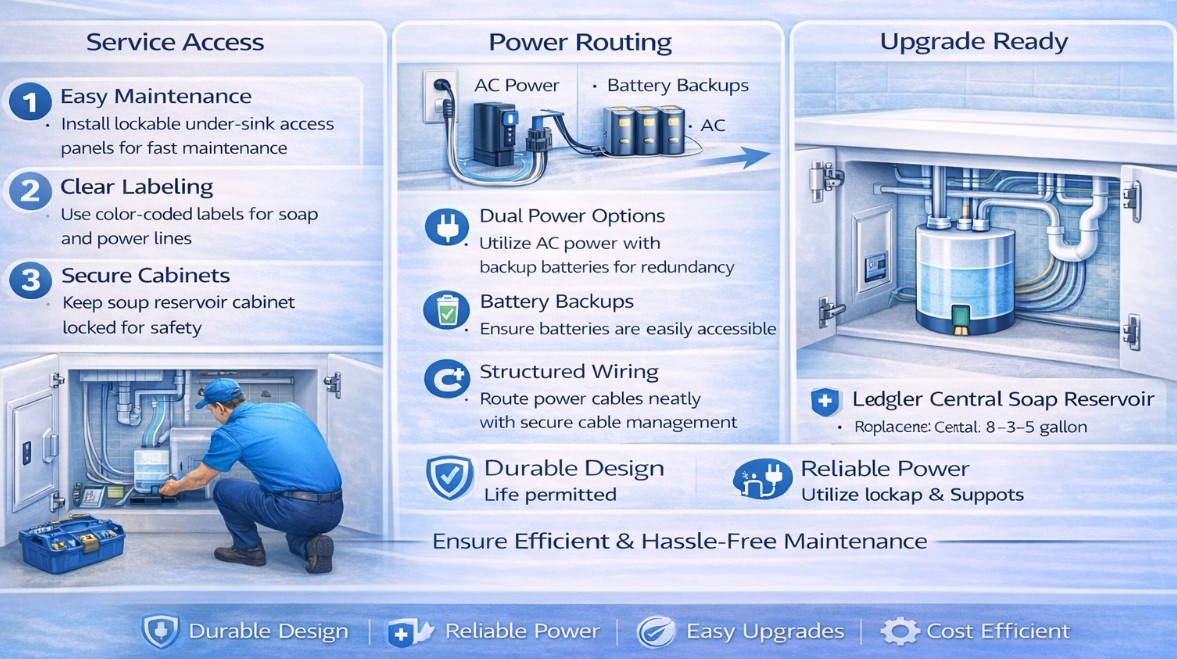
Multi site restroom programs fail when service access and power routing are treated as “maintenance details” instead of design decisions. In portfolio work, small differences between locations compound fast: different keying, inconsistent battery access, gateways plugged into janitor closet outlets that get switched off, or refill tanks buried behind casework. The result is predictable: more work orders, more downtime, and inconsistent user experience across the same brand standard.
Manufacturers also confirm that service actions can affect performance. GOJO notes that after opening and closing the cover, an LTX dispenser may take up to 30 seconds to activate because it auto calibrates to surrounding lighting conditions. That matters for refill workflow planning and staff expectations.
This guide focuses on service access design, power strategy, and routing best practices that scale across multiple buildings.
Working definition
Service access means the physical ability to refill, clean, and repair the dispenser without removing finishes, disassembling casework, or placing staff in awkward positions.
Power routing means how electrical power is delivered and maintained over time, including batteries, hardwired low voltage, and network gateways that require continuous power.
Multi site best practice means the solution remains consistent across buildings, is easy to train, and has predictable replacement parts and service steps.
Start with a standard service model for the whole portfolio
Before selecting products, define how facilities teams actually work:
- Who refills dispensers (in house, contractor, hybrid)
- Typical service frequency (daily, twice weekly, event based)
- Whether staff has keys for locked units
- Whether service happens during occupied hours
- Whether the owner wants data driven service (IoT monitoring) or manual rounds
If IoT is part of the strategy, remember that gateways need continuous power. Tork’s Gateway LTE M product description states the gateway must be plugged into a power supply at all times to capture and send sensor data.
Service access rules that reduce downtime in heavy use restrooms
A) Keep refill access fast and non destructive
The most common service failures happen when staff must:
- Remove a dispenser to open it
- Reach under deep counters with limited clearance
- Move stored items to access a refill bottle
- Use tools that chip stone or scratch stainless
Best design moves:
- Provide clear vertical and horizontal access zones for the service person
- Avoid locating refill points behind paper towel chutes, trash bins, or sharp corners
- Standardize lock type and keying across the entire site
B) Avoid placing “critical” components in conflict zones
Critical components include:
- Sensor windows
- Refill caps and fill ports
- Control boxes for multi feed systems
- Gateway power supplies
In multi station systems, control boxes and tank assemblies often need accessible mounting locations. Bradley’s Top Fill Multi Feed Soap System installation manual describes power supply connection routing to the multi feed tank assembly and control boxes and cautions to use the approved power harness.
C) Plan for calibration behavior after service
If a dispenser auto calibrates after service, staff needs to know that the first activation may be delayed. GOJO LTX troubleshooting guidance states it can take up to 30 seconds to properly activate once the cover is closed because the unit is auto calibrating to lighting conditions.
Portfolio best practice:
- Put a short note in the O and M guide and train staff so they do not log false failures right after refill.
Batteries vs hardwired power: choose based on labor, not preference
Battery powered dispensers
Advantages:
- Faster retrofit
- No electrician needed at each location
- Fewer coordination points
Risks:
- Battery waste and recurring labor
- Missed changeouts in high traffic zones lead to downtime
- Corrosion risk in humid environments if battery compartments are neglected
Best practice for batteries:
- Set a scheduled battery replacement interval for high traffic restrooms
- Standardize battery type and quantity across models
- Require battery access without removing the unit from the wall
Hardwired or low voltage systems
Advantages:
- Avoids battery labor and waste
- Better for heavy use locations with strict uptime requirements
- Better fit for centralized multi feed systems
Risks:
- Power routing must be coordinated early
- More points of failure if harnessing and connections are not protected
- Requires service access to control boxes and power supplies
Bradley’s multi feed installation manual explicitly covers power supply connections for the tank assembly and control boxes and cautions to use the approved harness. This is a strong signal that power routing is a system design issue, not only an electrical note.
Power routing best practices for multi site consistency
A) Use dedicated, non switched power where required
Gateways and controllers should not be plugged into outlets that can be switched off or used for cleaning equipment. Tork’s gateway description states it must remain plugged into power at all times for sensor data capture and transmission.
Best practice:
- Provide dedicated receptacles and label them for restroom monitoring equipment
- Avoid janitor closet outlets that are frequently unplugged
B) Protect cables and harnessing in wet, high use environments
Routing should avoid:
- Drip lines from faucets or fill ports
- Floor contact where mops pull cords
- Sharp cabinet edges that cut insulation over time
For multi feed systems, follow manufacturer harness guidance and avoid improvised splices. Bradley warns to only use the approved Top Fill Multi Feed Power Harness.
C) Document the power map per restroom
For multi site work, include a simple “restroom power map” in closeout:
- Location of controllers, gateways, and supplies
- Circuit identification
- Shutoff access and lockout steps
- Service access instructions
This reduces troubleshooting time during staff turnover and contractor changes.
Accessibility and operable parts considerations during service
Even though dispensers are touch free for users, they still have operable parts for maintenance: locks, cover latches, buttons, and switches. The Access Board operable parts guide explains that operable parts in accessible spaces must meet requirements and provides general coverage context.
Also, ADA 309.4 operation requires operable parts to be usable with one hand and not require tight grasping, pinching, twisting of the wrist, and not more than 5 pounds of force.
Design and spec implications:
- Do not specify service latches that require excessive force
- Ensure locks and release mechanisms are reachable and not blocked by plumbing
Multi site maintenance planning: reduce parts variation
The fastest way to increase maintenance cost is to mix:
- Different refill formats
- Different battery types
- Different lock keys
- Different sensor tuning behaviors
- Different mounting heights and placements
Portfolio best practice:
- Pick one or two dispenser families for most restrooms
- Standardize refill type and case pack
- Standardize keys and locks
- Use the same mounting height and placement rules everywhere
If the owner is using multi station systems, note that the Bradley multi feed system is designed for multiple handwashing stations and can supply up to six dispensers, which may simplify refills but increases the importance of service access for the tank and controls.
AEC checklist: service access and power routing
A) Service access
- Refill access without removing the unit
- Clear service zone under counters and inside cabinets
- Standard keying and lock strategy
- Sensor window reachable for cleaning
B) Power strategy
- Battery replacement interval defined for high traffic areas
- For gateways, dedicated non switched power provided
- For multi feed systems, approved harness and controller routing documented
C) Commissioning
- Verify activation after service and calibration delay behavior
- Confirm all power points remain live during typical cleaning routines
- Provide a restroom level power and device map in closeout documentation
Conclusion
In multi site commercial restroom programs, the biggest reliability gains come from designing service access and power routing as repeatable standards. Fast refill access, consistent keys and parts, dedicated always on power for gateways, and protected harness routing reduce downtime and shrink maintenance labor. Manufacturer guidance reinforces that service actions can trigger calibration behavior and that certain systems require specific power harnessing, which makes early coordination essential. When these decisions are standardized across locations, touch free dispensers become predictable assets instead of recurring trouble tickets.
Supporting References
GOJO LTX troubleshooting guide, auto calibration after servicing (support document)
https://medsite123.com/wp-content/uploads/2024/pdf/ltx_-_troubleshooting_guide.pdf
GOJO product data sheet excerpt on auto calibration and priming behavior (support document)
https://d213yzj61vi89h.cloudfront.net/Bunzl-MLN-Site/attachments/en_US/ProductDataSheet/100147_366395_ProductDataSheet.pdf
Bradley Top Fill Multi Feed Soap System installation and maintenance manual, power supply and harness guidance (support document)
https://media.bradleycorp.com/view/30048/215-1935.pdf
Bradley Verge multi feed soap tank manual copy, includes power supply connections section (support document)
https://www.berls.com/content/site/PDFs/Bradley_Verge_Soap_Multifeed_Manual.pdf
Tork Gateway LTE M, continuous power requirement (reference page)
https://www.torkglobal.com/us/en/product///693940
ADA Access Board operable parts guide (support document)
https://www.access-board.gov/files/ada/guides/operable-parts.pdf
2010 ADA Standards 309.4 operation, 5 lbf maximum force (reference)
https://codes.iccsafe.org/s/ADA2010P1/chapter-3-building-blocks/ADA2010P1-Ch03-Sec309.4
No responses yet