For
CommercialSoapDispenserAuto.com
Future Trends: Smart Soap Dispensers, Usage Analytics & Predictive Maintenance
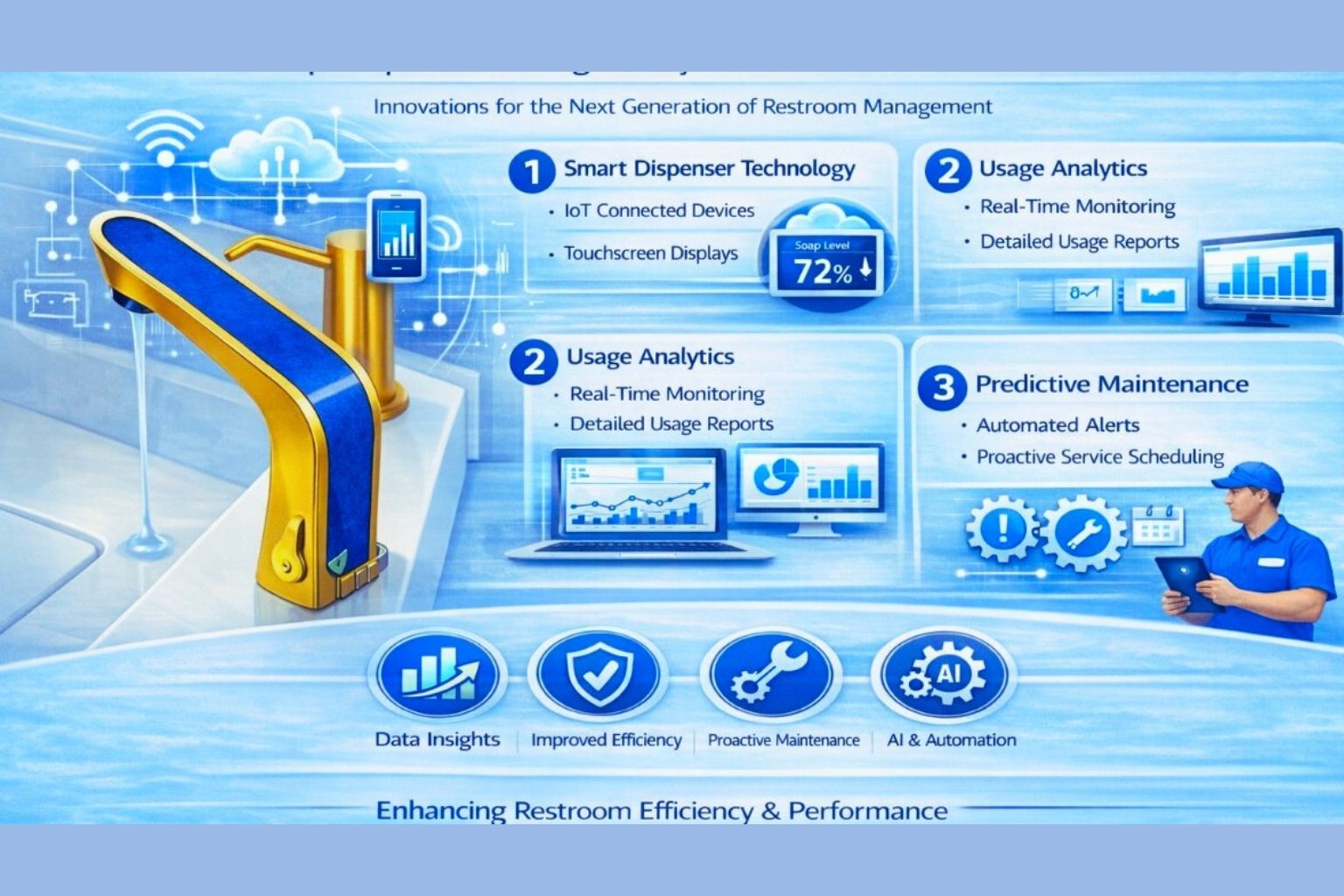
Smart soap dispensers are becoming part of connected restroom infrastructure, especially in multi-site portfolios where the real cost is labor, downtime, and inconsistent availability. The trend is not just “IoT dispensers.” It is a shift toward data-driven hygiene operations where dispenser status, consumption, and service alerts feed a workflow for refill routing and maintenance planning.
Commercial platforms already support connected soap and sanitizer dispensers, refill-level visibility, dashboards, and integrations through APIs. https://www.torkglobal.com/us/en/products-and-services/our-services/tork-vision-cleaning https://www.torkglobal.com/ca/en/product/652920
Working definition
Smart soap dispenser means a dispenser that can report one or more operational states such as low refill, empty, battery status, fault status, or activations, typically through a gateway or access point.
Usage analytics means converting dispenser signals into measurable indicators such as activations per day, estimated doses per day, refill interval, and location-based demand patterns.
Predictive maintenance means using signals like low battery, repeated faults, irregular dispensing, and abnormal consumption patterns to service devices before users experience outages. GOJO describes a service-alert approach that aims to reduce complaints and work orders by monitoring dispenser fleet health. https://www.gojo.com/-/media/GOJO-Site/Markets/Electronic-Monitoring-Systems/Files/PURELL-SMARTLINK-Service-Alerts-User-Guide-V2-92023–Healthcare.pdf
What “smart” means in restroom dispensing today
Connected dispensing is generally built from four layers:
A) The dispenser or retrofit sensor
Some systems retrofit an existing dispenser family with a sensor unit that tracks refill status and consumption. Tork’s Dose Sensor is an example, built to track refill status and consumption for connected soap and sanitizer dispensers. https://www.torkglobal.com/ca/en/product/652920
B) Connectivity layer
Many commercial deployments use Bluetooth access points, gateways, or low-power networks to carry data out of the restroom. Tork’s connected sensor approach notes the need for indoor access points or a gateway. https://www.torkglobal.com/ca/en/product/652920
C) Software layer for dashboards and routing
Operations teams use apps or dashboards that highlight dispensers needing attention and support targeted cleaning. Tork positions Vision Cleaning around “know when to refill and clean” using connected dispensers and people counters. https://www.torkglobal.com/us/en/products-and-services/our-services/tork-vision-cleaning
D) Integration layer
Connected hygiene systems increasingly expose data through APIs to connect with broader building operations platforms. Tork’s Dose Sensor page states that data can be shared with other apps via the Tork Vision API. https://www.torkglobal.com/ca/en/product/652920
Usage analytics that actually help AEC and facility teams
Data is only useful when it supports decisions. The most practical metrics for multi-site restrooms are:
Activations and estimated doses per day
This is the baseline for sizing refill intervals, staffing, and consumption forecasting. For design teams, it can also validate whether certain locations are under-designed for peak periods.
Empty time as a performance KPI
A connected system can measure how long a dispenser remains empty, which is a direct occupant experience metric. A Tork Vision Cleaning brochure discusses results measured across thousands of connected dispensers, including time in an empty status and reductions in dispenser checks. https://tork-images.essity.com/images-c5/513/402513/original/tork-tvc-4pagebrochure-0622.pdf
Location-based demand patterns
Restrooms near cafeterias, lobbies, or clinic check-in can behave differently from back-of-house restrooms. Analytics can justify different refill schedules, different refill formats, or different dispenser capacities per zone.
Service event analytics
Alerts like low refill, low battery, or communication loss can be tracked to evaluate maintenance quality and identify problematic locations. GOJO’s SMARTLINK Service Alerts guide describes monitoring that keeps teams informed about dispenser fleet health, with the aim of reducing complaints and work orders. https://www.gojo.com/-/media/GOJO-Site/Markets/Electronic-Monitoring-Systems/Files/PURELL-SMARTLINK-Service-Alerts-User-Guide-V2-92023–Healthcare.pdf
Predictive maintenance is replacing reactive rounds
Traditional restroom maintenance relies on periodic rounds. Predictive maintenance changes the model:
Predictive refill timing
Some monitoring platforms provide predictive refill information based on usage. The SMARTLINK Service Alerts app description references predictive refill information based on dispenser usage. https://play.google.com/store/apps/details?hl=en-US&id=com.gojo.smartlink.SA
Battery replacement planning
Battery status alerts allow batteries to be replaced on a schedule aligned to predicted depletion, reducing “dead dispenser” events.
Early detection of failure modes
Repeated “fault” alerts or abnormal activation patterns can indicate:
- sensor obstruction or lens film
- pump wear
- refill seating issues
- nuisance activation from reflections or traffic
These become maintainable issues rather than user complaints.
What research suggests about connected sanitary supply monitoring
Beyond commercial product ecosystems, research prototypes show how IoT monitoring can be used to track sanitary supplies including liquid soap.
A 2025 Springer conference paper describes an IoT-based embedded prototype for real-time monitoring of sanitary supplies including liquid soap, with the goal of gathering accurate data to support planning and timely replenishment. https://link.springer.com/chapter/10.1007/978-3-032-09738-5_2
Related research in facilities management contexts also explores sensor networks and low-power communication for tracking sanitizer station usage and supporting operations. https://www.mdpi.com/2624-6511/4/3/51
Why this matters for AEC:
- Connected dispensing is part of a broader smart-facility pattern.
- Owners increasingly expect equipment that can report status, not just function.
Hygiene certifications and why “smart” often pairs with sealed refills
Smart dispensing does not automatically improve hygiene. However, connected systems are often specified alongside controlled refill formats because it supports consistent operation and contamination risk reduction.
WELL v2 hand washing contamination reduction includes a requirement for liquid soap in dispensers with disposable and sealed soap cartridges at sink locations. https://standard.wellcertified.com/v2/nourishment/hand-washing
Design implication:
- When WELL is a project goal, sealed refills can align with the hygiene strategy, and smart monitoring can help ensure availability stays high.
Future direction: restroom analytics as part of building operations
The next evolution is not only dispenser-level alerts. It is a restroom operations layer that combines:
- people counting
- dispenser consumption
- cleaning verification
- service route optimization
Tork positions its platform around combining people counters and connected dispensers to target cleaning and reduce tasks like routine dispenser checks. https://www.torkglobal.com/us/en/products-and-services/our-services/tork-vision-cleaning
Expect more integration into:
- computerized maintenance management systems
- building management dashboards
- ESG reporting and operational KPIs
API availability becomes important when owners want data to flow into existing tools. Tork’s Dose Sensor page notes data sharing via the Tork Vision API. https://www.torkglobal.com/ca/en/product/652920
Specification checklist for smart dispensers in multi-site projects
A) Connectivity and power
- Define how data leaves the restroom (gateway, access point, network type)
- Require continuous power for gateways where applicable
- Confirm signal coverage and commissioning steps
B) Data outputs that matter
- Low refill, empty status, and predicted refill timing
- Battery status and fault alerts
- Usage metrics suitable for planning (activations, estimated doses)
GOJO’s service alert approach emphasizes dispenser health monitoring to reduce complaints and work orders. https://www.gojo.com/-/media/GOJO-Site/Markets/Electronic-Monitoring-Systems/Files/PURELL-SMARTLINK-Service-Alerts-User-Guide-V2-92023–Healthcare.pdf
C) Cyber and privacy considerations
- Clarify whether data is aggregated at location level or includes any user-level tracking
- Require owner approval for any badge-based or person-linked monitoring if proposed
D) Hygiene alignment
- If WELL is targeted, include sealed cartridge requirement where applicable
- Ensure refill format matches maintenance capacity and infection control strategy https://standard.wellcertified.com/v2/nourishment/hand-washing
E) Portfolio standardization
- Standardize hardware families, gateways, and spare parts
- Standardize naming conventions for locations so analytics remain clean across sites
Conclusion
Smart soap dispensers are moving toward connected hygiene ecosystems where refill status, consumption, and device health alerts support targeted service instead of manual checks. Usage analytics can reduce empty time, improve refill planning, and stabilize occupant experience across large portfolios. Predictive maintenance becomes practical when alerts include low refill forecasting, battery status, and fault detection, supported by dashboards and API integration pathways. WELL-aligned projects often pair these systems with sealed cartridge strategies to support contamination reduction and consistent availability. https://www.torkglobal.com/us/en/products-and-services/our-services/tork-vision-cleaning https://www.gojo.com/-/media/GOJO-Site/Markets/Electronic-Monitoring-Systems/Files/PURELL-SMARTLINK-Service-Alerts-User-Guide-V2-92023–Healthcare.pdf https://standard.wellcertified.com/v2/nourishment/hand-washing
Supporting References
Tork Vision Cleaning overview
https://www.torkglobal.com/us/en/products-and-services/our-services/tork-vision-cleaning
Tork Dose Sensor 3.0 for soap and sanitizer dispensers, refill status and consumption, API mention
https://www.torkglobal.com/ca/en/product/652920
Tork Vision Cleaning brochure PDF (connected dispensers, KPI concepts, measured results)
https://tork-images.essity.com/images-c5/513/402513/original/tork-tvc-4pagebrochure-0622.pdf
PURELL SMARTLINK Service Alerts user guide PDF (fleet health, alerts, reducing work orders)
https://www.gojo.com/-/media/GOJO-Site/Markets/Electronic-Monitoring-Systems/Files/PURELL-SMARTLINK-Service-Alerts-User-Guide-V2-92023–Healthcare.pdf
SMARTLINK Service Alerts app listing (predictive refill info reference)
https://play.google.com/store/apps/details?hl=en-US&id=com.gojo.smartlink.SA
Research prototype for data-driven sanitary supply monitoring including liquid soap (2025)
https://link.springer.com/chapter/10.1007/978-3-032-09738-5_2
IoT sensor network for tracking sanitizer station usage in facilities management (MDPI)
https://www.mdpi.com/2624-6511/4/3/51
WELL v2 hand washing feature library (sealed cartridge requirement under contamination reduction)
https://standard.wellcertified.com/v2/nourishment/hand-washing
Category pages for system context
https://www.bobrick.com/product-catalog/categories/soap-dispensers-faucets/
https://www.bradleycorp.com/product-category/soap-dispenser
https://americanspecialties.com/product_category/soap-dispensers/
No responses yet