For
CommercialSoapDispenserAuto.com
Foam vs Liquid Dispensing: Pros, Cons & Application Suitability in Commercial Restrooms
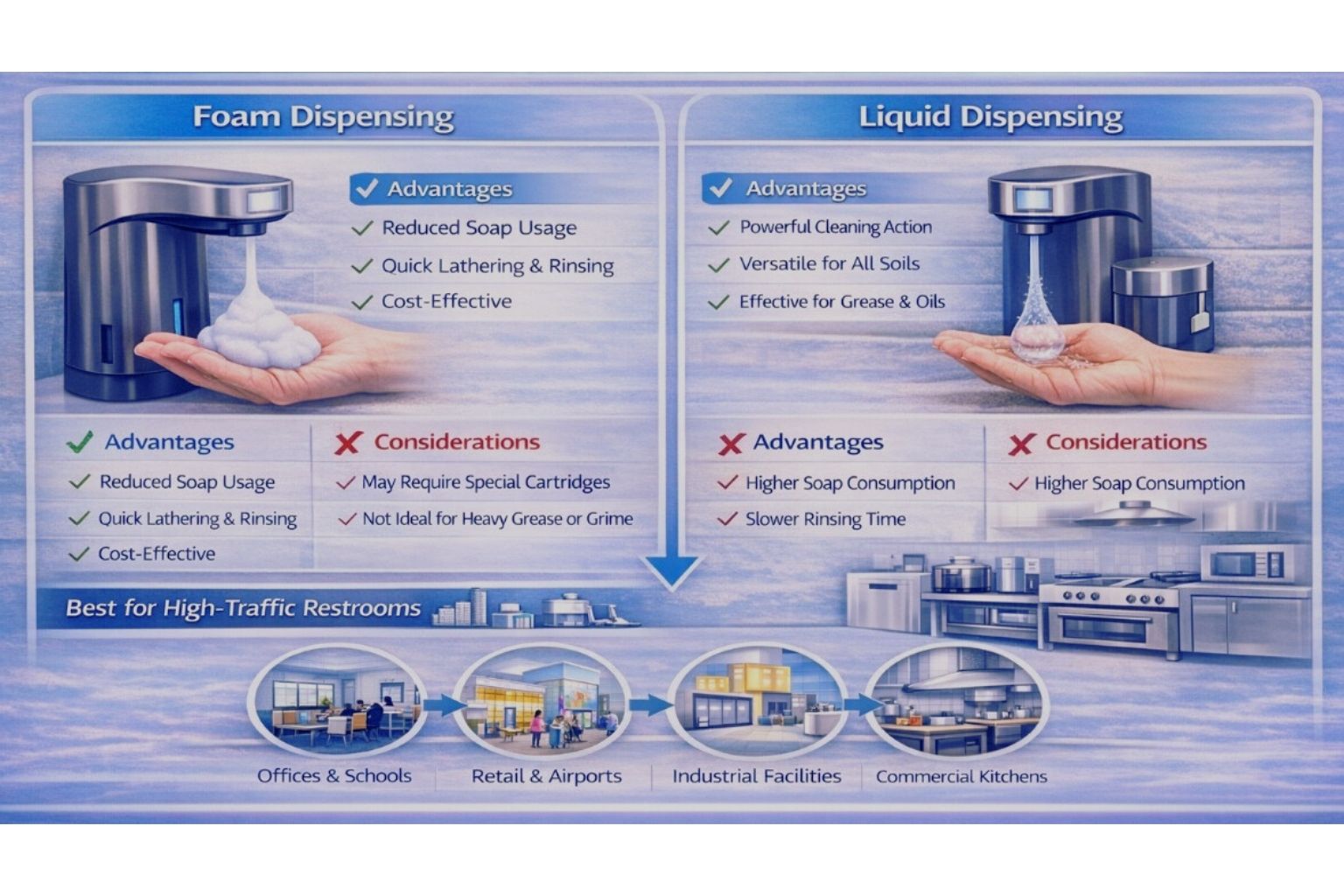
Foam and liquid soap systems can both support effective hand hygiene in commercial restrooms. The difference for AEC teams is rarely aesthetics. It is performance in the sink zone, refill logistics, maintenance burden, and how predictable the system stays under high traffic use.
Soap selection also sits inside a bigger hygiene framework. CDC guidance consistently emphasizes washing hands with soap and clean running water as the best method in most situations. https://www.cdc.gov/clean-hands/about/index.html
This guide compares foam and liquid dispensing from a specifier perspective: dose control, user behavior, residue and cleanup, refill systems, and where each format is usually the better fit.
Working definition
In this article:
Foam soap means liquid soap dispensed through a pump mechanism that mixes product with air to create foam.
Liquid soap means a non-foaming hand soap dispensed as liquid, either from sealed refills or bulk reservoirs.
Dispensing performance means dose per activation, consistency between activations, and how residue behaves on surfaces and nozzles.
Application suitability means matching soap type to traffic level, user population, and facilities staffing.
The AEC decision framework: what matters most
If you want a reliable, low-complaint installation, evaluate foam vs liquid using five field variables:
- Dose size and dose consistency
- User behavior, including repeat activations
- Residue, drip risk, and sensor window fouling
- Refill method and contamination controls
- Maintenance access, parts, and standardization across a portfolio
Category pages can help you see which manufacturers support both formats and which systems are designed around top-fill or bulk.
Bobrick Soap Dispensers and Faucets category: https://www.bobrick.com/product-catalog/categories/soap-dispensers-faucets/
Bradley Soap Dispenser category: https://www.bradleycorp.com/product-category/soap-dispenser
ASI Soap Dispensers category: https://americanspecialties.com/product_category/soap-dispensers/
Foam soap: pros and constraints
Pros of foam dispensing
Lower product mass per handwash can extend refill intervals
Many foam systems are designed to deliver more doses per refill compared with liquid. A Tork foam soap product data sheet lists 2,500 doses from a 1,000 mL refill for its foam system. https://dgduupz79pcvd.cloudfront.net/documents/fusion/752593_datasheet.pdf
For AEC planning, this can support:
- Longer replenishment intervals in medium traffic restrooms
- Fewer emergency refills during peak periods
- Smaller storage footprint per handwash volume
Better perception of coverage for some users
Foam spreads quickly and can feel like full-hand coverage even at a smaller dose. That can help reduce excessive product use in settings where users over-pump liquid soap.
Can support sustainability narratives when paired with measured dosing
Some manufacturers publish internal testing claims around reduced soap consumption and water use for foam versus liquid. Treat these as manufacturer test claims rather than code requirements, but they can help owners think about staffing and logistics. https://cdn.images.fecom-media.com/FE00008537/documents/52050150_ProductInformationSheet_24_04_2025_GrcHHlQqpE.pdf
Constraints and risks of foam dispensing
Efficacy findings in published studies are mixed and context-dependent
A frequently cited AJIC study reported that, in their tests, nonantimicrobial foam soap was not as effective as liquid soap at reducing hand bacterial load. https://www.sciencedirect.com/science/article/pii/S0196655317300822
There is also published debate and discussion in the journal via letters to the editor, which is a reminder that study design, soap formulation, and handwashing technique all influence results. https://www.ajicjournal.org/article/S0196-6553(17)31040-4/fulltext
AEC takeaway:
- Do not treat foam as automatically inferior or superior
- Treat soap selection as one variable inside a complete handwashing design that includes water, drying, signage, and maintenance
Foam nozzles and screens can be more sensitive to dried residue
Foam delivery often uses mixing elements that can clog if cleaning is inconsistent or if soap chemistry changes. In high splash zones, residue can build at the nozzle and around sensor windows faster than teams expect.
Liquid soap: pros and constraints
Pros of liquid dispensing
Straightforward product path and broad soap compatibility
Liquid systems often tolerate a wider range of formulations, and many facilities already stock standard liquid soaps. This can reduce procurement complexity.
Clear behavior for users in high accountability environments
Some environments prefer liquid because users understand how much they are getting and can adjust. In healthcare, behavior and technique can matter as much as the dispenser.
Often simpler troubleshooting
When a liquid system fails, the failure is often a predictable set: empty reservoir, blocked nozzle, battery issue, or valve failure. That can reduce diagnostic time in facilities with limited training.
Constraints and risks of liquid dispensing
Higher drip risk and countertop mess if dose is not controlled
Liquid is more likely to drip along spouts, pool on decks, and create visible residue trails. This increases cleaning frequency and can make a restroom look unmaintained even when it is serviced regularly.
Users often pump multiple times, increasing consumption variability
If the unit is slow to dispense or dose is too small, users commonly re-trigger the sensor, which can erase expected consumption assumptions.
Contamination and hygiene controls: refill method matters more than foam vs liquid
The highest contamination risk is typically associated with open bulk refill practices, especially topping off without cleaning.
Peer-reviewed research has found bulk soap refillable dispensers can be prone to extrinsic bacterial contamination. https://journals.asm.org/doi/10.1128/AEM.02632-10
A field study in food service environments also evaluated microbial quality in open refillable bulk soap. https://www.sciencedirect.com/science/article/pii/S0362028X22084575
Specifier controls that reduce risk for either soap type:
- Prohibit topping off in bulk systems
- Require reservoir cleaning intervals in O and M manuals
- Prefer sealed refills in facilities with high staff turnover or strict hygiene programs
Application suitability: where foam tends to fit best
Airports, arenas, convention centers
Foam often fits well because dose efficiency can extend refill intervals and reduce emergency refills. The key is to keep the nozzle and sensor lens out of the primary splash zone.
Education campuses and office portfolios
Foam can reduce consumption variability, especially when dispensers have consistent dosing. Portfolio owners also tend to value predictable replenishment planning.
Front-of-house restrooms with high cleanliness expectations
Foam can reduce drip trails, but only if dose and placement are coordinated so product dispenses over the basin.
Support documents for product families that support both foam and liquid bulk approaches can be useful for system planning across a building.
Bobrick soap dispenser brochure: https://www.bobrick.com/wp-content/uploads/Bobrick_Soap_Dispensers_Brochure.pdf
Application suitability: where liquid tends to fit best
Industrial and back-of-house areas
Facilities often prefer liquid where users may have heavier soil loads and need a familiar soap behavior, and where procurement wants flexibility.
Retrofits with existing bulk liquid infrastructure
If a building already has bulk liquid standards and the owner has cleaning protocols, liquid can be the lower-disruption path.
Locations where soap formulation must be tightly controlled
Some sites have standardized soap chemistry requirements for skin sensitivity or food-handling considerations. Liquid programs may be more established in those environments.
Specifier checklist: foam vs liquid, written in measurable terms
Use this checklist to keep the decision technical and submittal-friendly.
A) Dose and refill planning
- Dose per activation stated in mL or grams
- Estimated doses per refill stated on the data sheet
Example reference with doses per refill: https://dgduupz79pcvd.cloudfront.net/documents/fusion/752593_datasheet.pdf - Target replenishment interval aligned to staffing rounds
B) Placement and sink-zone coordination
- Dispenser location dispenses over basin, not over deck
- Avoid direct spray on nozzle and sensor lens
- Verify behavior with the actual faucet spray pattern and splash geometry
C) Hygiene and refill controls
- Sealed refills or bulk refill rules clearly documented
- No topping off rule for bulk systems
- Reservoir cleaning interval and method included
Evidence base for bulk refill risk: https://journals.asm.org/doi/10.1128/AEM.02632-10
D) Maintenance and lifecycle
- Locking and service access defined
- Replacement parts availability confirmed
- Cleaning method for nozzle and sensor lens included
E) Owner-facing documentation
- Approved soap types and substitutions policy
- Training note for janitorial staff on refill and cleaning steps
CDC hand hygiene context: https://www.cdc.gov/clean-hands/about/index.html
Conclusion
Foam and liquid soap dispensing can both succeed in commercial restrooms when the specification is written around dose control, refill method, and maintainable sink-zone detailing. Foam often supports longer refill intervals and can reduce drip mess when dosing is consistent, while liquid can be easier to standardize in some operations programs and can be more familiar in back-of-house environments. The largest hygiene risk is usually not foam versus liquid. It is uncontrolled bulk refill practices and inconsistent cleaning. Align the soap format with the owner’s staffing capacity, then document refill rules and cleaning access so the system performs the same way in year five as it did at commissioning.
Supporting References
https://www.cdc.gov/clean-hands/about/index.html
https://www.sciencedirect.com/science/article/pii/S0196655317300822
https://www.ajicjournal.org/article/S0196-6553(17)31040-4/fulltext
https://dgduupz79pcvd.cloudfront.net/documents/fusion/752593_datasheet.pdf
https://cdn.images.fecom-media.com/FE00008537/documents/52050150_ProductInformationSheet_24_04_2025_GrcHHlQqpE.pdf
https://journals.asm.org/doi/10.1128/AEM.02632-10
https://www.sciencedirect.com/science/article/pii/S0362028X22084575
https://www.bobrick.com/product-catalog/categories/soap-dispensers-faucets/
https://www.bobrick.com/wp-content/uploads/Bobrick_Soap_Dispensers_Brochure.pdf
https://www.bradleycorp.com/product-category/soap-dispenser
https://americanspecialties.com/product_category/soap-dispensers/
No responses yet