For
CommercialSoapDispenserAuto.com
Environmental Impact: Energy Use, Reusable Refill Systems & LEED/ WELL Certifications
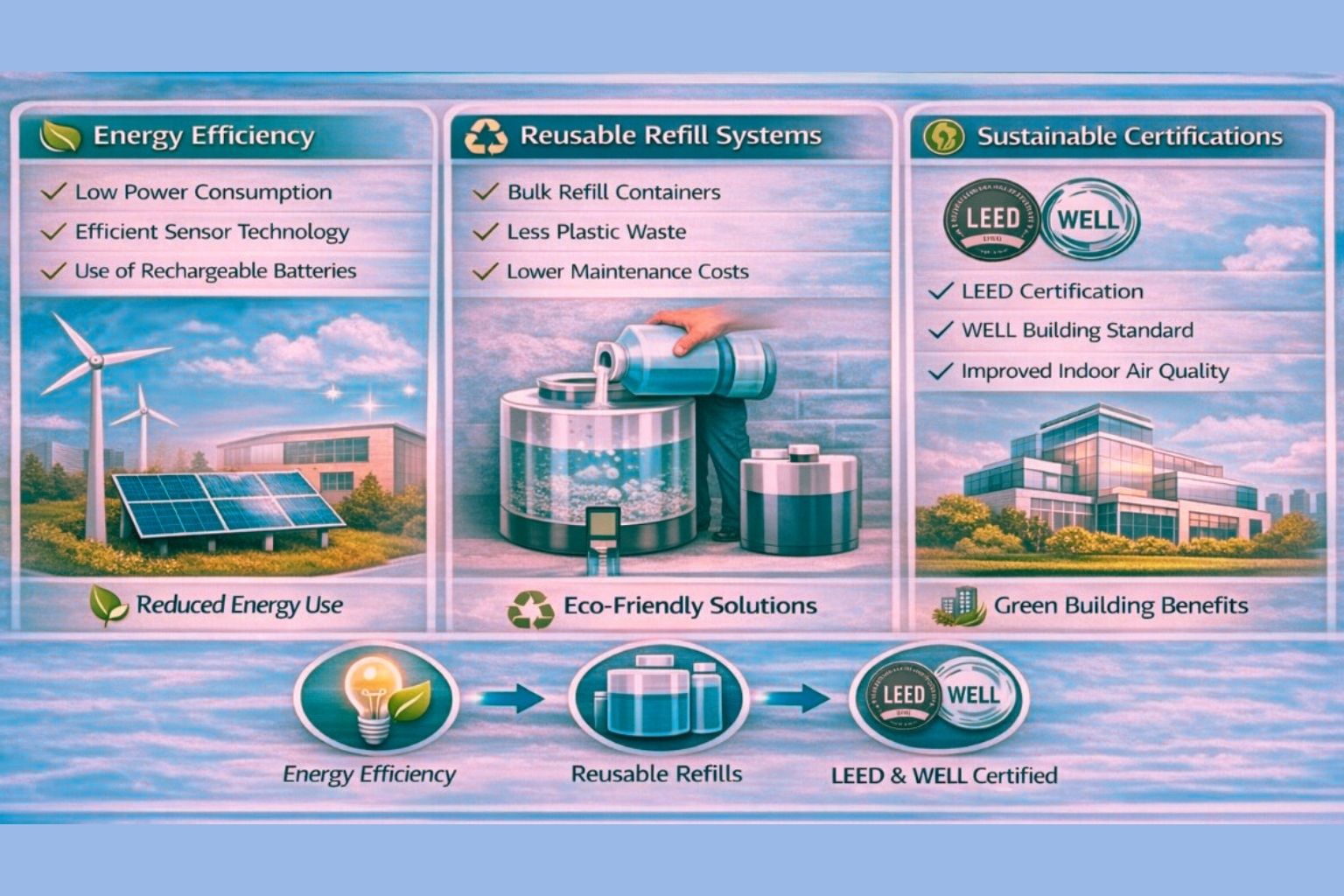
Automatic soap dispensers are now common in commercial restrooms because they support touch reduction and consistent dosing. For AEC teams, the sustainability question is not only touchless versus manual. Environmental impact comes from three measurable areas: energy and batteries, consumable packaging and refill logistics, and how the system aligns with certification documentation pathways.
WELL is explicit that handwashing infrastructure includes soap dispensers and that soap and dispenser choices can reduce contamination risk when sealed cartridges are used. https://standard.wellcertified.com/v2/nourishment/hand-washing
LEED is more indirect for dispensers, but dispensers can still matter in materials documentation, waste planning, and product transparency strategies. USGBC publishes LEED v4.1 documentation guidance for common materials credits like Environmental Product Declarations and Material Ingredients that can apply to many building products when manufacturers provide the right paperwork. https://www.usgbc.org/sites/default/files/2023-01/4.1%20Product%20Compliance%20Checklists%20and%20Tips.pdf
Working definition
In this article:
Energy use means power demand over the service life, including standby power, battery replacements, and end of life battery handling.
Reusable refill systems means refill approaches that reduce packaging waste per dose, such as sealed bag refills, bag in box, or closed containers designed for controlled refilling and cleaning.
LEED and WELL alignment means that the dispenser and refill program can support documentation and operational requirements in those frameworks, especially material transparency for LEED and hygiene support for WELL. https://standard.wellcertified.com/v2/nourishment/hand-washing
1) Energy profile of sensor dispensers
Most automatic dispensers spend their time in standby mode and activate briefly to run a small pump. Per unit energy is small, but the building scale matters. A campus can have hundreds of dispensers, and battery logistics become a real operational and environmental stream.
Key energy variables to specify:
- Power type: alkaline battery, rechargeable pack, or hardwired low voltage
- Expected battery life under the facility’s traffic profile
- Low battery signaling and maintenance workflow
- Electronics features that increase draw, such as networked monitoring
A practical sustainability baseline is to treat batteries as a managed consumable, not an afterthought. EPA’s battery collection best practices toolkit is useful for building operators designing battery collection and recycling processes. https://www.epa.gov/electronics-batteries-management/battery-collection-best-practices-toolkit
2) Battery waste and safer collection planning
Automatic dispensers can create recurring battery waste if maintenance is reactive rather than scheduled. This is both cost and environmental burden.
Recommended spec language topics:
- Define battery chemistry allowed by the owner
- Require clear battery access that does not need removing the unit from the wall
- Require a battery collection route and storage protocol for spent batteries
- Require labeling or maintenance documentation that prevents batteries going into general trash
EPA’s broader sustainable management hub for electronics and batteries is a helpful reference point for facility programs and collection strategy. https://www.epa.gov/electronics-batteries-management
3) Refill systems drive most of the environmental footprint
From a lifecycle view, the soap itself and its packaging can outweigh the dispenser body over time. A dispenser may last years. Refills cycle weekly or monthly.
Three common commercial refill models:
Sealed cartridge or bag refills
Advantages:
- Lower contamination risk when compared to open bulk topping off
- Predictable changeouts, fewer mess events
- Often easier to standardize across a portfolio
WELL’s Hand Washing feature includes contamination reduction criteria that call for liquid soap in dispensers with disposable and sealed cartridges. https://standard.wellcertified.com/v2/nourishment/hand-washing
Tradeoffs:
- More packaging per liter than bulk fill in many cases
- Recycling depends on material type and local infrastructure
Bulk fill or top fill reservoirs
Advantages:
- Potentially less packaging waste per liter
- Good fit where maintenance staff is trained and consistent
Risk:
- Research literature shows bulk soap refillable dispensers are prone to extrinsic bacterial contamination under real world conditions, and contaminated soap can increase hand contamination after washing. https://journals.asm.org/doi/10.1128/aem.02632-10
- Field research in food service settings also reports bacterial detection issues tied to bulk soap characteristics and facility type. https://www.sciencedirect.com/science/article/pii/S0362028X22084575
If bulk is used, sustainable practice requires a cleaning and disinfection procedure, no topping off, and defined training.
Bag in box systems
Advantages:
- Large volume refills reduce packaging per delivered liter
- Supports long replenishment intervals in industrial and high traffic settings
Bag in box is widely used in janitorial supply markets for 5 liter class refills, which is a useful benchmark when sizing refill logistics. https://www.carefreejanitorial.com/catalog/p/GJYH555EACH/PRO-LINK-5000-Plus-Bag-in-Box-System-Dispenser/
4) Dispenser body impacts: materials, durability, and end of life
Sustainability is strongly linked to service life. A dispenser that fails early creates both waste and maintenance travel.
What to evaluate:
- Housing material: stainless steel, durable polymers, or metal alloys
- Locking and vandal resistance features that prevent breakage
- Modular service parts like pumps and sensor windows
A second end of life lever is recycling of dispenser bodies. Some manufacturers have dispenser recycling pathways. For example, Tork DispenserCircle describes collection and recycling of used dispensers via a partner process. https://tork-images.essity.com/images-c5/117/544117/original/en-2024-flyer-tork-dispensercircle-final-.pdf
Kimberly-Clark Professional also markets a sustainability services program aimed at landfill diversion and lifecycle impact tracking, which can be relevant for portfolio owners standardizing restroom equipment. https://www.kcprofessional.com/en-us/sustainability/thrive-sustainability-services
5) How this ties into WELL certification
WELL is the most direct framework for soap dispensing decisions because it addresses hygiene support and handwashing infrastructure.
WELL Hand Washing includes requirements related to accessibility of sinks and soap dispensers and includes a contamination reduction pathway that calls for sealed disposable soap cartridges. https://standard.wellcertified.com/v2/nourishment/hand-washing
In practice, WELL alignment typically favors:
- Sealed refills in high risk or high variability staffing environments
- Clear placement and access so soap is consistently available
- Maintenance documentation that prevents unsafe refill behaviors
Supporting documents for WELL strategy interpretation can also be useful in project narratives, especially when the owner is pursuing WELL Health Safety rating in addition to WELL v2. https://cdn.wellcertified.com/resources/health-safety/WELL%2BHealth-Safety%2BRating_FINAL.pdf
6) How this ties into LEED documentation
Soap dispensers do not typically drive LEED Water Efficiency credits the way faucets and flush fixtures do, but they can still matter in LEED project workflows:
Materials and Resources documentation
Dispensers can be included in a project’s materials strategy when manufacturers provide:
- Environmental Product Declarations for lifecycle impact disclosure
- Material ingredient reporting such as Health Product Declarations
USGBC’s LEED v4.1 Product Compliance Checklists and Tips is a practical reference for how LEED teams document EPD and material ingredient credits. https://www.usgbc.org/sites/default/files/2023-01/4.1%20Product%20Compliance%20Checklists%20and%20Tips.pdf
If an owner wants EPD-based disclosures, it helps to understand that EPD programs in construction commonly follow ISO 14025 and EN 15804 structures, with third party verification in many established programs like IBU. https://ibu-epd.com/en/epd-programme/
Waste and operations narratives
Refill packaging and batteries create operational waste streams. LEED teams often include operational planning and waste reduction narratives, even when points are earned elsewhere. A dispenser strategy that reduces packaging per dose, includes a battery collection plan, and supports recycling can strengthen the owner’s sustainability story.
7) Specifier checklist: environmental impact decisions that hold up on site
A) Energy and batteries
- Choose power strategy and document expected battery replacement cycle
- Require low battery signaling that facilities teams can manage
- Include a battery collection and recycling plan reference
EPA battery collection toolkit: https://www.epa.gov/electronics-batteries-management/battery-collection-best-practices-toolkit
B) Refill packaging and contamination controls
- Pick sealed cartridge or bag refills for high variability staffing or high hygiene risk
- If bulk fill is used, require cleaning and disinfection and a no top off rule
Bulk contamination research: https://journals.asm.org/doi/10.1128/aem.02632-10
C) End of life planning
- Prefer systems with published recycling or take-back options when available
Tork DispenserCircle PDF: https://tork-images.essity.com/images-c5/117/544117/original/en-2024-flyer-tork-dispensercircle-final-.pdf
D) LEED and WELL alignment
- WELL: confirm sealed refills and accessibility criteria for handwashing areas
WELL Hand Washing: https://standard.wellcertified.com/v2/nourishment/hand-washing - LEED: request EPD and material ingredient documents when the project targets MR credits
USGBC LEED v4.1 product compliance tips: https://www.usgbc.org/sites/default/files/2023-01/4.1%20Product%20Compliance%20Checklists%20and%20Tips.pdf
Conclusion
A sustainable automatic soap dispenser specification is mostly about lifecycle behavior: how often batteries are replaced, how much packaging is generated per dose, and whether the refill method stays hygienic without creating waste from failures and callbacks. WELL directly supports sealed cartridge strategies to reduce contamination risk, while LEED can reward product transparency documentation and broader sustainability practices. When the dispenser program is written as an operational system and not just a wall accessory, environmental impact becomes measurable and easier to manage across a building portfolio.
Supporting References
https://standard.wellcertified.com/v2/nourishment/hand-washing
https://cdn.wellcertified.com/resources/health-safety/WELL%2BHealth-Safety%2BRating_FINAL.pdf
https://www.usgbc.org/sites/default/files/2023-01/4.1%20Product%20Compliance%20Checklists%20and%20Tips.pdf
https://www.usgbc.org/leed/v41
https://ibu-epd.com/en/epd-programme/
https://www.epa.gov/electronics-batteries-management
https://www.epa.gov/electronics-batteries-management/battery-collection-best-practices-toolkit
https://journals.asm.org/doi/10.1128/aem.02632-10
https://www.sciencedirect.com/science/article/pii/S0362028X22084575
https://tork-images.essity.com/images-c5/117/544117/original/en-2024-flyer-tork-dispensercircle-final-.pdf
https://www.kcprofessional.com/en-us/sustainability/thrive-sustainability-services
https://www.carefreejanitorial.com/catalog/p/GJYH555EACH/PRO-LINK-5000-Plus-Bag-in-Box-System-Dispenser/
No responses yet