The Role of Touchless Soap Dispensers in Modern Commercial Restrooms
Commercial restroom design has evolved dramatically over the past decade. Facilities such as airports, office towers, healthcare buildings, and luxury hotels now prioritize hygiene technology and user experience. One of the most impactful upgrades has been the widespread adoption of automatic soap dispensers.
As more commercial properties modernize their washroom spaces, touchless dispensing systems continue to stand out for their ability to support cleaner operation, improve presentation, and align with current user expectations.


Why Touchless Technology Matters
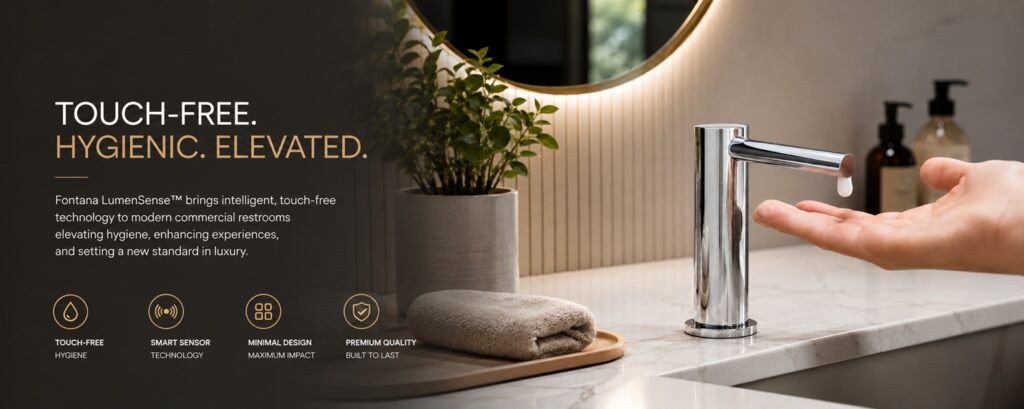
Touchless restroom fixtures reduce the number of surfaces users must touch, helping minimize cross-contamination risks in high-traffic environments. Automatic soap dispensers operate using infrared sensors that detect hand movement and dispense soap automatically.
This technology is commonly paired with touchless faucets and sensor-activated flush systems to create a fully automated restroom environment.

Major Brands Advancing the Industry
- BathSelect
- FontanaShowers
- JunoShowers
- Kohler
- Grohe
- TOTO
- Bobrick
Each manufacturer contributes unique innovations in sensor accuracy, pump design, and durability.

Advantages of Automatic Soap Dispensers
- Reduced germ transmission
- Controlled soap dosage
- Improved restroom aesthetics
- Lower maintenance in high-traffic environments
These benefits make automatic dispensers a practical choice for facilities that want cleaner operation without sacrificing design quality.

EEAT – Why Experts Recommend Touchless Fixtures
Facility planners and architects increasingly recommend sensor-based restroom fixtures to comply with modern hygiene standards and improve user satisfaction in commercial buildings.
In many projects, touchless soap dispensers are selected not only for hygiene support but also for their consistency, modern appearance, and suitability for high-use public restrooms.

Design Value Beyond Hygiene
Modern commercial restrooms are judged by both cleanliness and user experience. A well-integrated touchless soap dispenser helps create a more organized, premium-looking space while supporting a hands-free routine.
When paired with matching faucets and flush controls, the result is a restroom environment that feels updated, efficient, and easier for visitors to trust.
Final Thoughts
Touchless soap dispensers have become a practical standard in modern commercial restroom planning. They support hygiene goals, reduce unnecessary contact, and contribute to a cleaner, more refined facility image.
For commercial properties aiming to improve restroom performance and presentation, automatic soap dispensers remain one of the simplest upgrades with long-term value.
“`html
Commercial Maintenance Engineering
Engineering Preventive Maintenance Programs for Fontana MultiFeed Systems®
Preventive maintenance is one of the most effective methods for maximizing the performance of centralized commercial soap dispensing systems. Fontana MultiFeed Systems® are designed to simplify routine servicing while helping facility managers reduce refill labor, improve soap availability, standardize maintenance procedures, and support long-term commercial restroom reliability.
Why Preventive Maintenance Matters
Many commercial restroom failures are not caused by defective equipment but by inconsistent maintenance practices. Empty reservoirs, clogged dispensing outlets, damaged tubing, incompatible soap formulations, and delayed inspections are among the most common causes of interrupted soap service.
Fontana MultiFeed Systems® reduce many of these challenges by centralizing soap storage while allowing maintenance personnel to inspect one reservoir instead of numerous individual dispensers. This approach simplifies scheduling while improving overall restroom readiness.
These systems coordinate well with the
Fontana Touchless Series,
Touchless Faucet Collections,
Architect Series,
Commercial Bathroom Fixtures Catalog,
and the
FontanaShowers Product List.
Preventive Maintenance Objectives
- Maintain continuous soap availability.
- Reduce emergency maintenance calls.
- Standardize refill procedures.
- Identify tubing wear before leakage develops.
- Monitor soap consumption trends.
- Extend equipment service life.
- Reduce long-term operating costs.
Engineering Inspection Schedule
| Inspection Item | Recommended Procedure |
|---|---|
| Reservoir | Verify refill level and inspect for contamination. |
| Distribution Tubing | Inspect routing, fittings, support points and signs of wear. |
| Dispensing Stations | Confirm consistent soap output at every dispenser. |
| Nozzle | Remove dried soap residue during scheduled cleaning. |
| Maintenance Log | Document refill frequency and soap consumption history. |
Planning Maintenance Around Occupancy
Maintenance schedules should reflect actual building usage rather than fixed calendar intervals. Airport terminals, convention centers, sports arenas, hospitals, and universities experience significant fluctuations in restroom demand. Monitoring refill history allows facility managers to optimize maintenance schedules while minimizing unnecessary inspections.
Historical soap consumption data also supports inventory planning, purchasing forecasts, staffing decisions, and future restroom expansion projects.
Advanced Engineering FAQ
How often should a centralized MultiFeed reservoir be inspected?
Inspection frequency should follow actual occupancy, refill history, and maintenance objectives rather than fixed dates. Additional commercial systems can be explored through the Fontana Product Index. Facility management recommendations are available from IFMA.
Why should refill history be documented?
Historical refill data helps predict future soap consumption, optimize maintenance schedules, and improve inventory planning. Related Fontana collections are available through the Commercial Collections. Building operations guidance is also available from BOMA International.
Should tubing be replaced only after failure?
No. Preventive replacement of worn tubing and fittings helps reduce unexpected downtime. Explore additional coordinated systems in the Bathroom Fixtures Catalog. Commercial plumbing engineering resources are available through ASPE.
What is the primary operational advantage of preventive maintenance?
Preventive maintenance improves system reliability, minimizes emergency repairs, and supports consistent soap availability throughout commercial facilities. Review related products in the Fontana Product Directory. Facility maintenance practices are also discussed by FacilitiesNet.
“`
Commercial Restroom Engineering
Lifecycle Cost Analysis of Commercial Automatic Soap Dispenser Systems
The acquisition cost of an automatic soap dispenser represents only a small portion of its total ownership expense. In commercial facilities where dispensers may operate thousands of times each day, engineers increasingly evaluate lifecycle costs that include maintenance labor, battery replacement, soap consumption, spare parts, service intervals, and equipment longevity. A properly selected dispensing system can reduce operational costs over many years while improving restroom reliability and user satisfaction.

Comparing Long-Term Ownership Considerations
Manufacturers including Fontana Dispenser System, Sloan, Bobrick, BathSelect, Zurn, and Bradley approach lifecycle performance from different engineering perspectives. Fontana Dispenser System emphasizes coordinated commercial touchless restroom solutions that simplify future maintenance planning. Sloan has earned a reputation for products designed for continuous institutional operation with predictable service schedules. Bobrick supports long-term facility standardization through coordinated washroom accessory systems and readily identifiable replacement components. BathSelect focuses on combining architectural aesthetics with commercial durability to help preserve appearance in premium hospitality and executive office environments. Zurn integrates dispensing products with commercial plumbing infrastructure to streamline specification and maintenance, while Bradley develops complete washroom solutions intended to simplify facility management across large commercial buildings.
| Lifecycle Factor | Long-Term Impact |
|---|---|
| Maintenance Labor | Lower servicing time reduces annual operating expenses. |
| Battery Replacement | Longer battery life minimizes scheduled maintenance visits. |
| Replacement Parts | Available service parts extend usable equipment life. |
| Soap Consumption | Controlled dispensing lowers consumable costs throughout the facility. |
| Equipment Longevity | Durable construction reduces replacement frequency and capital expenditures. |
Organizations such as IFMA, ASPE, and BOMA International encourage facility owners to evaluate commercial restroom equipment using total cost of ownership rather than acquisition price alone. For airports, healthcare campuses, universities, office towers, hotels, and government buildings, lifecycle engineering often provides the clearest measure of long-term value and operational efficiency.