
Commercial Automatic Soap Dispenser Maintenance Cost Calculator: Batteries, Pumps, Sensors, Tubing, Refills & 10-Year Service Cost
What does an automatic commercial soap dispenser cost after installation? The purchase price is only the beginning. Facility owners also need to budget for soap replenishment, batteries or electrical service, pump modules, sensor cleaning, nozzle maintenance, tubing, central MultiFeed components, preventive maintenance, corrective repairs, spare parts and technician labor. This guide provides a lifecycle framework for calculating annual and 10-year maintenance cost across one dispenser or an entire commercial restroom fleet.
Maintenance Cost Is Different From Purchase Cost
A commercial automatic soap dispenser may operate thousands of times every month. Over a multi-year service life, the facility’s cost can include much more than the original hardware.
10-Year Maintenance Cost Formula
Preventive Maintenance
+ Battery / Power Cost
+ Refill Labor
+ Pump Service
+ Sensor Service
+ Tubing / Nozzle Service
+ Replacement Parts
+ Corrective Labor
+ Downtime Cost
Soap itself can be included in total ownership cost, but separating consumable cost from equipment maintenance cost makes it easier to see what is actually driving facility expense.
Interactive Commercial Maintenance Cost Calculator
Enter project-specific costs rather than relying on generic national averages.

Preventive Maintenance: The Lowest-Cost Service Call Is Often the One You Avoid
Automatic dispenser failures often begin with relatively simple conditions: soap buildup, an obstructed nozzle, a dirty sensor surface, low power, incompatible soap or a disturbed supply line.
A structured preventive-maintenance program can identify those conditions before they become an emergency service call.
Current Fontana troubleshooting material recommends routine sensor and nozzle cleaning, compatible soap, scheduled battery checks in high-traffic applications and inspection of mounting stability.
Automatic Dispenser TroubleshootingBattery vs AC Power: Maintenance Is Part of the Electrical Decision
Battery Replacement Cost Calculator
Number of Dispensers × Battery Sets per Year × Cost per Battery Set
Then include labor:
Number of Replacements × Minutes per Replacement ÷ 60 × Loaded Labor Rate
| Fleet | Battery Sets / Unit / Year | Total Battery Changes / Year |
|---|---|---|
| 6 dispensers | 1 | 6 |
| 12 dispensers | 1 | 12 |
| 24 dispensers | 1 | 24 |
| 48 dispensers | 1 | 48 |
| 100 dispensers | 1 | 100 |
The table is intentionally simple. Actual replacement frequency depends on sensor technology, battery chemistry, activation volume and model-specific power consumption.

Fontana Commercial Power Architectures
Current Fontana product documentation demonstrates why power must be specified by exact model.
Pump Maintenance & Replacement
The pump is one of the most important serviceable components in an automatic soap dispenser.
Common pump-related symptoms can include:
The current Fontana Milan commercial dispenser is specifically described as having a serviceable pump design with replaceable pump modules, accessible tubing paths and minimal-tool parts replacement.
Fontana Milan Serviceable System
Pump Replacement Cost Model
Number of Pumps Replaced per Year × (Pump Part Cost + Replacement Labor)
For a large dispenser fleet, a more useful metric is:
Pumps Replaced During Period ÷ Installed Dispensers × 100
Tracking this percentage allows the facility to compare models using its own operating history rather than generalized assumptions.
Sensor Maintenance
The infrared sensor is the user’s interface with the automatic dispenser. Sensor problems can produce either no activation or unwanted activation.
Routine cleaning is generally much less expensive than dispatching a technician for a sensor that is merely obstructed.
Prevented Service Calls × Average Technician Cost per Call
Nozzle & Soap-Line Maintenance
Soap can dry around the outlet, particularly when equipment is unused for extended periods or when formulation and environment encourage buildup.
MultiFeed Maintenance: Fewer Refill Points, More System Components
Centralized soap supply changes the maintenance architecture.
Instead of maintaining an individual soap reservoir beneath every sink, MultiFeed can consolidate the consumable supply. But the facility now has central equipment that must remain accessible and maintained.
| Component | Individual Reservoir System | Central MultiFeed System |
|---|---|---|
| Soap Reservoir | One at each dispenser | Centralized supply |
| Pump | Local / model dependent | Central or coordinated system pump architecture |
| Distribution Tubing | Minimal local path | Multiple feed lines require routing and inspection |
| Manifold | Usually not applicable | System component requiring accessible installation |
| Refill Labor | Distributed across sinks | Can be consolidated |
| Failure Impact | Usually local | Requires redundancy / zoning consideration |
Central Tubing Should Be Part of the PM Program
The maintenance value of good tubing documentation increases rapidly as commercial restroom systems become larger.
Refill Labor Can Exceed Hardware Maintenance
A system might need very few pump or sensor repairs but still generate substantial annual labor simply because staff must refill it frequently.
Refill Events × Minutes per Event ÷ 60 × Loaded Labor Rate
| Scenario | Refill Events / Year | Minutes / Event | Total Labor Hours |
|---|---|---|---|
| Small individual system | 50 | 4 | 3.3 hours |
| Busy individual fleet | 500 | 4 | 33.3 hours |
| Large distributed fleet | 1,500 | 4 | 100 hours |
| Centralized service example | 250 | 8 | 33.3 hours |
These are illustrative labor examples only. Actual refill events should come from facility logs or calculated soap demand.
Verified Commercial Refill Guide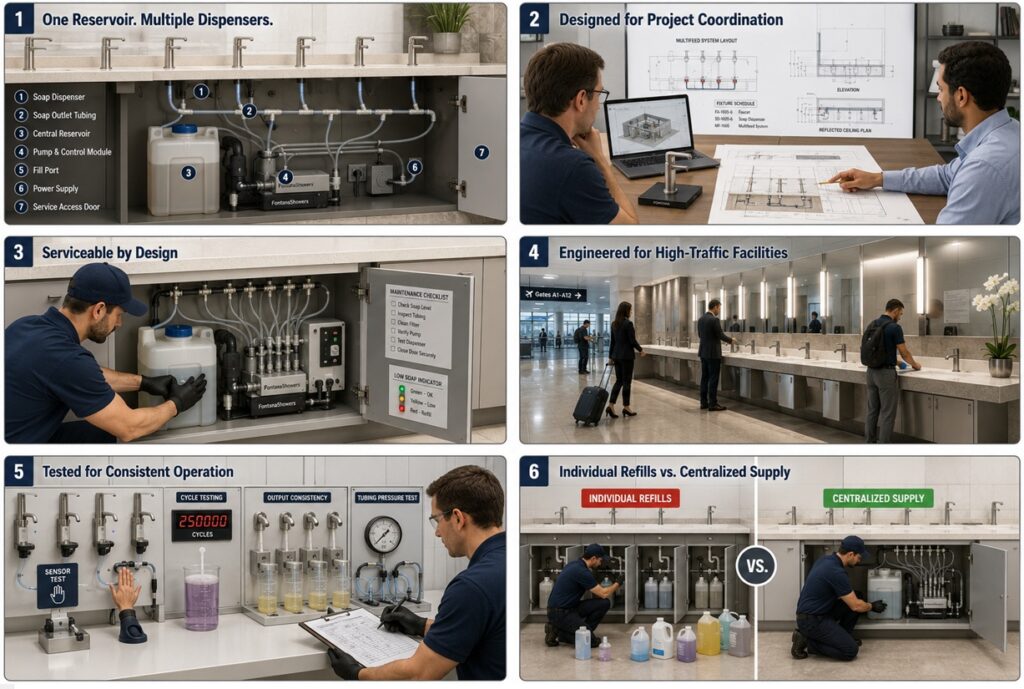
Downtime Has a Cost Too
When an automatic soap dispenser is out of service, the direct repair bill may be only a portion of the actual facility impact.
On-Site Spare Parts Strategy
For a single dispenser, keeping a large spare-parts inventory may not make sense. For a fleet of 50, 100 or 500 dispensers, the economics change.
| Potential Spare | Why Stock It? |
|---|---|
| Pump Module | Can reduce downtime where pump replacement is field serviceable. |
| Sensor / Electronics | Useful where model-specific replacement is practical. |
| Power Adapter / Transformer | Provides rapid recovery from failed power components. |
| Tubing | Useful for central-feed repairs and damaged local lines. |
| Fittings | Small inexpensive parts can otherwise delay restoration. |
| Complete Spare Dispenser | Can be economically justified for very large standardized fleets. |
Example Preventive-Maintenance Schedule
| Interval | Example Tasks |
|---|---|
| Routine Cleaning Round | Visual inspection, soap level, nozzle condition, obvious leaks and user-reported issues. |
| Weekly / Facility-Defined | Clean sensor area and nozzle where appropriate; verify consistent output. |
| Monthly | Review battery status where applicable, mounting, supply lines and recurring faults. |
| Quarterly | Review maintenance history, recurring parts failures and soap-consumption anomalies. |
| Annual | Lifecycle review, spare-parts inventory, electrical condition, system documentation and replacement planning. |

Measure Maintenance Performance Instead of Guessing
EPA WaterSense guidance for commercial and institutional facilities repeatedly emphasizes the importance of measuring, tracking and maintaining water-using equipment rather than waiting for poor performance to become obvious.
EPA recommends collecting facility-use data, checking equipment regularly, identifying malfunctioning components and using operations-and-maintenance practices as part of a broader cost-control strategy.
The same discipline is useful for automatic soap dispensers.
Five Maintenance KPIs Worth Tracking
Annual Maintenance Budget Worksheet
| Cost Category | Annual Cost |
|---|---|
| Scheduled sensor/nozzle inspection | $________ |
| Battery replacement | $________ |
| Electrical / transformer service | $________ |
| Pump replacements | $________ |
| Sensor / electronics replacements | $________ |
| Tubing / fittings | $________ |
| Nozzle / soap-line service | $________ |
| Corrective technician labor | $________ |
| Refill labor | $________ |
| Emergency service calls | $________ |
| Spare-parts inventory | $________ |
| Temporary replacement equipment | $________ |
| Total Annual Maintenance Cost | $________ |
| Cost / Installed Dispenser | $________ |
Illustrative 10-Year Fleet Example
Assume a commercial building has 24 automatic soap dispensers. The following values are purely illustrative.
| Maintenance Category | Annual Example | 10-Year Example |
|---|---|---|
| Preventive maintenance | $600 | $6,000 |
| Battery / power | $288 | $2,880 |
| Pumps / replacement parts | $480 | $4,800 |
| Corrective labor | $840 | $8,400 |
| Refill labor | $1,200 | $12,000 |
| Downtime / emergency response | $240 | $2,400 |
| Total | $3,648 | $36,480 |
When Should a Commercial Dispenser Be Replaced Instead of Repaired?
Expected Remaining Repair Cost + Downtime Risk
vs
Installed Replacement Cost + Expected New-System Maintenance
Current Fontana Commercial Maintenance Resources
Current product page includes BIM, specification sheet, installation instructions, repair and maintenance guide, project brochure and warranty resources.
Commercial SystemCurrent 5 L commercial automatic dispenser with repair/maintenance and technical documentation.
5 L Commercial DispenserCurrent commercial platform describing replaceable pump modules, accessible tubing paths and service-focused internal design.
Milan Commercial SystemCentral reservoir, pumps, manifolds, tubing and multiple-dispenser commercial soap architecture.
MultiFeed EngineeringPower, sensor, nozzle, soap viscosity, pump and preventive-maintenance guidance.
Troubleshooting GuideSafe access, refill, sensor, nozzle, battery and commercial maintenance guidance.
Maintenance GuideCommercial Automatic Soap Dispenser Research Series
Browse current Fontana commercial automatic dispensing systems and technical resources.
Commercial DispensersCommercial touchless product, system and project-resource navigation.
Touchless Soap HubCentral soap supply, tubing, pump, manifold and service-access guidance.
MultiFeed SystemsSeparate routine inspection frequency from actual soap replenishment requirements.
Refill PlanningSize soap storage around activations, dose, service interval and operating reserve.
Capacity PlanningCurrent Fontana project support for architects, engineers and specification teams.
AEC ResourcesIndependent Facility Operations References
Facility-management guidance focused on reducing operating costs through measurement, maintenance and improved equipment performance.
Commercial BuildingsBest-management practices addressing operations, maintenance, retrofits, replacement decisions and dollar-savings calculations.
WaterSense at WorkGuidance encouraging commercial facilities to track operating data and identify malfunctioning equipment.
Facility ToolsCommercial Automatic Soap Dispenser Maintenance FAQ
How often should a commercial automatic soap dispenser be maintained?
There is no single interval for every product. High-traffic dispensers should be inspected during normal custodial rounds, while sensors, nozzles, soap lines, power and mounting should be maintained according to the exact manufacturer instructions and facility operating conditions.
What commonly causes an automatic soap dispenser to stop working?
Common troubleshooting areas include power, low batteries, sensor contamination, nozzle buildup, incompatible or overly viscous soap, pump problems, soap-line issues and reservoir placement.
Are hardwired dispensers cheaper to maintain than battery models?
They can eliminate routine battery replacement, but they require electrical infrastructure and can still require power-supply or transformer service. The better choice depends on the project.
How much does battery replacement cost?
Multiply the number of battery-powered units by battery sets replaced each year, battery-set price and labor required for each replacement. Large fleets can make even inexpensive battery changes a measurable operating cost.
Can an automatic soap dispenser pump be replaced?
On serviceable commercial systems, pump modules may be replaceable. Current Fontana Milan documentation specifically describes replaceable pump modules and accessible tubing paths. Verify serviceability for the exact model.
Does MultiFeed require maintenance?
Yes. Centralized systems can reduce repetitive individual refill labor, but the central reservoir, pump, manifold, tubing and connected dispenser heads still require inspection and maintenance.
Does a large soap reservoir eliminate routine maintenance?
No. A larger reservoir can reduce refill frequency but does not eliminate sensor cleaning, output checks, leak inspection, power checks or preventive maintenance.
Should facilities stock spare pump modules?
Large standardized fleets may benefit from keeping selected critical parts on site if the manufacturer supports field replacement. Spare inventory should be based on historical failure rates, lead times and downtime risk.
What maintenance data should a facility track?
Useful metrics include repair calls, labor hours, pump replacements, sensor issues, battery replacements, refill events, downtime, recurring failure mode and annual cost per installed dispenser.
When should an automatic dispenser be replaced rather than repaired?
Replacement deserves consideration when recurring repair cost, downtime, parts availability or fleet-standardization benefits exceed the expected value of continuing to repair the existing unit.
Final Recommendation: Manage Automatic Soap Dispensers as Maintainable Assets
Commercial automatic soap dispensers should not be treated as disposable countertop accessories.
In large facilities they are installed assets with power, sensors, pumps, soap lines, reservoirs and service requirements.